


What You Need to Know Before Renting with a Dog
Apartment breed restrictions are rules set by landlords or property managers that prohibit certain dog breeds — and their mixes — from living on the property. Before you start your rental search, here is a quick overview of what to expect:
Quick Answer: Apartment Breed Restrictions at a Glance
| Topic | Key Fact |
|---|---|
| What they are | Rules banning specific dog breeds from a rental property |
| Why they exist | Insurance requirements, liability risk, and local legislation |
| Who enforces them | Landlords, property managers, and HOAs |
| Who is exempt | Qualified service animals and emotional support animals (ESAs) under the Fair Housing Act |
| How to respond | Pet resume, DNA testing, liability insurance, references |
| Legal status | Generally legal for private landlords in all U.S. states |
Nearly 60 million U.S. households own at least one dog — yet many rental properties maintain strict limits on which breeds are welcome. If you are apartment hunting with a dog, breed restrictions can be one of the most frustrating surprises to encounter after you have already fallen in love with a unit.
Understanding the rules upfront saves time, protects your lease, and keeps your pet safe.
This guide walks through everything dog owners need to know — from which breeds are most commonly restricted, to your legal rights, to practical steps for getting approved even when your dog is on a restricted list.
Understanding Apartment Breed Restrictions and Why They Exist
When looking for a new home, discovering that your four-legged family member is on a property's prohibited list can feel like hitting a brick wall. But why do apartment breed restrictions exist in the first place? Contrary to popular belief, property managers rarely set these policies out of personal dislike for specific dogs. In most cases, these policies are driven by business structures, legal guidelines, and insurance requirements.

The primary force behind breed restrictions is commercial property insurance. Insurance carriers maintain underwriting guidelines that identify certain dog breeds as higher risk for liability claims. In the United States, insurance providers payout substantial sums annually for dog-related injury claims, with average claims exceeding tens of thousands of dollars. To minimize financial exposure, insurance providers publish carrier exclusion lists. If a residential building permits a breed on that blacklist, the property owner risks facing drastically increased insurance premiums or losing liability coverage altogether.
Beyond insurance mandates, property management teams must navigate several other operational priorities:
- Liability Risk Management: Preventing dog bites, physical injuries, or incidents on common grounds like hallways, elevators, and outdoor courtyards.
- Bite History Statistics: Reliance on historical claim data and national injury statistics, regardless of an individual dog's temperament.
- Property Damage Controls: Limiting damage to flooring, drywall, doors, and shared residential amenities.
- Noise and Nuisance Prevention: Managing persistent barking or territorial behavior that could impact neighboring residents.
- Local Municipal Legislation: Complying with municipal ordinances or district codes that regulate specific animal breeds.
Federal housing frameworks also provide context on how property policies operate. For example, federal standards outlined in the HUD Guidelines on Household Pets (HUD Handbook 4350.1 REV-1) outline clear rules for common household pets, registration, inoculation requirements, and pet rule enforcement within multi-family housing. While federally regulated housing developments have specific statutory caps on deposits and rule-making procedures, private market residential properties establish their own pet policies based on private contract law and state regulations.
Commonly Restricted Dog Breeds in Apartment Breed Restrictions
While every residential property maintains its own specific lease addendums, restricted breed lists across the country show a high degree of overlap. This uniformity occurs because most real estate companies rely on the same major commercial insurance blacklists.
If you share your life with one of the following breeds or a mix containing their lineage, you are likely to encounter apartment breed restrictions during your rental search:
- American Pit Bull Terriers, American Staffordshire Terriers, & Staffordshire Bull Terriers: Frequently grouped under the umbrella term "Pit Bulls," these breeds face the most widespread rental bans nationwide.
- Rottweilers: Often restricted due to their physical strength, size, and classification as guarding breeds by insurance carriers.
- German Shepherds: Commonly excluded by standard commercial insurance blacklists despite their popularity as working and family dogs.
- Doberman Pinschers: Frequently listed on insurance exclusion policies due to historical protective traits.
- Chow Chows: Restricted primarily because of insurance liability models regarding unpredictable temperaments around unfamiliar people.
- Akitas & Presa Canarios: Working and guarding breeds that trigger automatic red flags on standard risk-screening evaluations.
- Siberian Huskies & Alaskan Malamutes: High-energy northern breeds often excluded due to energy levels, shedding, and vocal traits like howling.
- Wolf Hybrids: Universally prohibited in residential apartment leases and standard commercial property policies.
- Boxers & Great Danes: Included on select property management restriction lists due to physical build or sheer size.
Mixed-breed dogs present an additional challenge. Many property managers enforce policies stating that if a dog is a mix of a restricted breed, the entire restriction applies. Because visual breed identification by human observation is notoriously inaccurate, mixed-breed dogs with broad heads, muscular frames, or short coats are often misidentified as restricted breeds during standard application reviews.
Weight and Age Limits in Rental Pet Policies
Breed type is not the only criterion property managers use to filter pets. Even if your dog's breed is fully permitted, you may run into secondary rules governing weight, age, and total animal counts.

Maturity Weight Caps
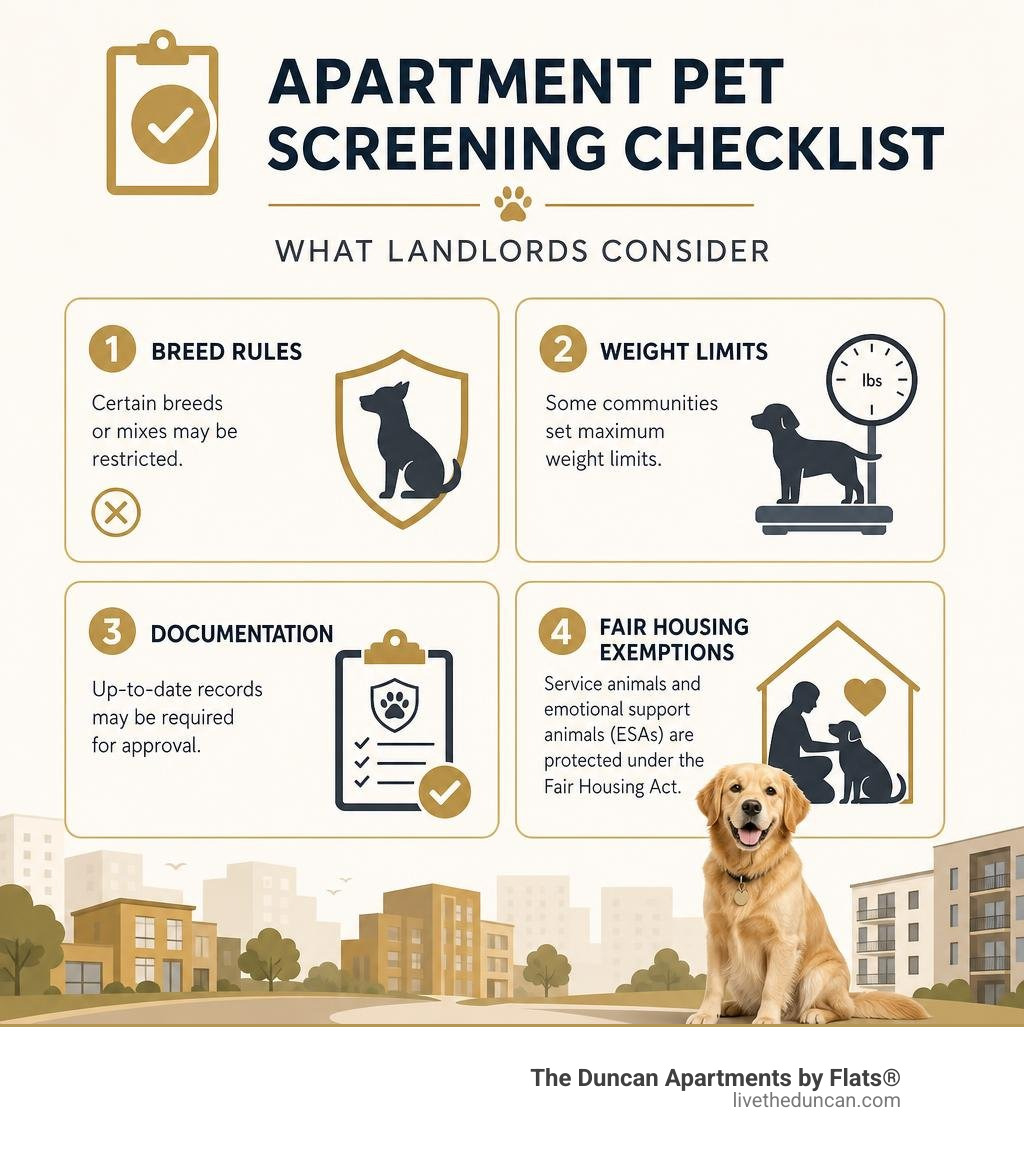
Many communities set maximum weight thresholds for resident pets. Typical weight limits range between 25 and 50 pounds at full maturity. These caps are often implemented to prevent wear and tear on flooring, minimize heavy footstep noise on upper levels, and ensure pets can be safely managed in shared spaces like elevators and lobbies.
Puppy Age Guidelines
Properties frequently enforce minimum age requirements, such as requiring pets to be at least one year old. Young puppies are higher risk for uncontained house-training accidents, chews on interior trim or baseboards, and frequent vocalization during crate training. Requiring pets to be past their initial puppyhood helps ensure they are fully house-broken and socialized for community living.
Two-Pet Limits
To maintain clean, quiet, and comfortable living spaces for all residents, property policies almost universally cap animal counts. Standard pet policies restrict households to a maximum of two pets per apartment. Attempting to bring additional animals beyond a two-pet threshold violates lease terms and can trigger formal lease default notices.
Legal Framework and Assistance Animal Exceptions
Navigating pet rules requires a clear understanding of the legal boundary between a standard household pet and a recognized assistance animal. Private landlords generally have the legal authority to set breed rules, weight limits, and pet fees for regular pets. However, federal civil rights laws establish distinct exceptions for individuals requiring assistance animals.

Under federal law, assistance animals fall into two distinct categories:
- Service Animals: Dogs (and in some cases miniature horses) individually trained to do work or perform tasks for the benefit of an individual with a physical, sensory, psychiatric, intellectual, or other mental disability.
- Emotional Support Animals (ESAs): Animals that provide essential emotional support that alleviates one or more identified symptoms or effects of a person's disability. ESAs do not require specialized task training.
How Fair Housing Rules Apply to Service Animals and ESAs
The Fair Housing Act explicitly states that assistance animals are not classified as pets. Consequently, standard property pet policies—including apartment breed restrictions, weight limits, pet deposits, non-refundable pet fees, and monthly pet rent—cannot be legally applied to qualified service animals or emotional support animals.
To properly request an accommodation under the Fair Housing Act, renters should keep the following operational requirements in mind:
- Disability Accommodation Requests: Tenants must formally request a reasonable accommodation from the property management team, identifying the need for an assistance animal to enjoy equal housing opportunities.
- Legitimate Medical Documentation: For non-obvious disabilities, housing providers may request documentation from a licensed mental health professional or healthcare provider establishing that the individual has a disability and that the animal provides disability-related support.
- Exemption from Breed Bans: A property manager cannot deny an assistance animal simply because its breed appears on an insurance blacklist or internal policy list.
- Direct Threat Exceptions: Fair Housing protections are not absolute. A housing provider can legally deny or revoke an accommodation if the specific individual animal poses a direct threat to the health and safety of others, or if it would cause substantial physical damage to the property that cannot be mitigated. This assessment must be based on objective evidence of the individual animal's actual behavior, not on generalized assumptions or breed stereotypes.
- Insurance Provider Obligations: Federal housing guidance clarifies that insurance carriers cannot force a landlord to deny an accommodation by threatening to cancel or modify a policy solely due to an assistance animal's breed, unless accommodating that specific breed imposes an undue financial or administrative burden.
How to Navigate Apartment Breed Restrictions as a Renter
If your beloved dog happens to fall onto a restricted breed list, do not lose hope. Unless you are dealing with a strict corporate policy backed by unyielding insurance rules, there are proven, professional ways to demonstrate that your pet is a well-behaved, low-risk resident.
When searching for dog-friendly Chicago apartments, approaching property teams with transparency, thorough documentation, and complete honesty is the best route to success. Attempting to hide a dog's breed or lie on a lease application creates immediate legal vulnerability and can lead to formal eviction proceedings.
How to Navigate Apartment Breed Restrictions Using Documentation
Presenting your dog as a well-trained, responsible companion requires compiling a professional "pet portfolio." By treating your pet's application with the same level of care as your personal rental application, you make it much easier for property managers to evaluate your request.
Assemble a comprehensive pet application packet containing the following documentation:
- A Detailed Pet Resume: Create a clean document that includes your dog's photo, age, weight, spay/neuter status, microchip number, and a brief description of their daily routine, training background, and calm personality.
- Complete Veterinary Records: Provide up-to-date health records showing current rabies vaccinations, routine inoculations, and confirmation of regular preventative care from a licensed veterinarian.
- Spay/Neuter Certification: Provide official medical proof that your dog has been altered. Spayed and neutered pets statistically demonstrate lower rates of territorial marking and aggression.
- Canine Good Citizen (CGC) Certification: Earning an American Kennel Club (AKC) Canine Good Citizen title proves that your dog has passed a recognized 10-step test assessing basic obedience, polite greeting manners, leash control, and reaction to distractions.
- Written Reference Letters: Include letters from prior landlords, property managers, neighbors, or professional dog trainers attesting to your dog's quiet behavior, lack of damage, and good manners in multi-family settings.
- Genetic DNA Test Results: If you have a mixed-breed rescue dog that visually resembles a restricted breed, ordering an official canine DNA test can scientifically verify their true genetic makeup. Demonstrating that your dog lacks dominant DNA from restricted breeds can clear up visual misidentifications.
Financial Incentives and Insurance Coverage
Financial reassurance can help put a property manager's risk concerns to rest. Showing that you have taken concrete financial measures to protect the physical apartment unit and surrounding common areas demonstrates high personal accountability.
Consider offering the following financial tools during negotiations:
- Refundable Pet Deposits: Offering a refundable pet deposit—typically ranging between $200 and $500 per animal—gives property owners dedicated funds to cover potential carpet cleaning or physical repairs upon move-out.
- Monthly Pet Rent: Agreeing to standard monthly pet rent payments provides property managers with ongoing compensation for animal presence and amenity upkeep.
- Pet Liability Coverage: Standard renters insurance policies often exclude specific dog breeds from liability coverage. You can secure a specialized renters policy or standalone pet liability policy that explicitly covers your dog's breed with up to $300,000 in liability coverage.
- Listing Landlords as Additional Insured: Adding your property management company or landlord as an "additional insured" on your pet liability policy ensures they are directly protected if an accidental injury or damage event occurs on-site.
Landlord Best Practices for Managing Pet Policies Fairly
For property owners, housing managers, and leasing agents, managing pet rules requires balancing resident retention with risk management. Blanket breed bans can turn away excellent, responsible tenants who happen to own gentle, well-trained dogs.
Adopting objective, behavior-based screening protocols allows management teams to maintain community standards while maximizing occupancy rates.
| Screening Approach | Blanket Breed Bans | Objective Behavioral Screening |
|---|---|---|
| Primary Focus | Visual appearance and breed stereotypes | Individual behavior and owner accountability |
| Applicant Pool | Excludes millions of responsible pet owners | Attracts high-quality, long-term residents |
| Risk Assessment | Relies on generalized insurance blacklists | Evaluates actual training, vet records, and references |
| Fair Housing Alignment | High risk of friction over visual misidentifications | Structured, transparent, and legally defensible |
| Resident Retention | Lower retention among pet-owning households | Higher resident satisfaction and longer tenure |
To build a fair, modern pet policy that protects property assets while welcoming responsible pet owners, property managers should implement these best practices:
- Establish Clear Written Pet Rules: Publish comprehensive written pet guidelines detailing animal limits (such as a two-pet limit per household), registration steps, waste cleanup duties, leash requirements, and noise controls.
- Conduct In-Person Pet Interviews: Schedule a quick 10-minute meet-and-greet with prospective pets on property grounds. Observing how a dog walks on a leash, responds to its owner, and interacts with new environments provides far better insight than visual breed assumptions.
- Require Annual Pet Registration Updates: Keep accurate digital records of all resident animals, including updated rabies certifications, local licenses, emergency contact details, and current photos. Synchronize pet updates with annual lease renewal processes.
- Provide Dedicated On-Site Pet Amenities: Installing convenient pet waste stations, pet wash facilities, or designated outdoor relief areas keeps common spaces clean and simplifies daily pet care for your community.
Frequently Asked Questions About Apartment Pet Rules
Are dog breed restrictions legal in rental housing?
Yes. Standard apartment breed restrictions are fully legal for private housing providers. Landlords and property management companies have the legal right to set pet guidelines, exclude specific animal breeds, enforce weight limits, or prohibit pets entirely under private lease contracts.
While certain states and municipalities have passed laws prohibiting local government agencies from enacting municipal breed-specific legislation (BSL), these public bans do not restrict private landlords from enforcing breed limits in private lease agreements. The primary legal exception applies to legitimate assistance animals protected under federal civil rights laws.
Can a landlord reject an emotional support animal due to breed?
Under the Fair Housing Act, a landlord cannot reject an emotional support animal (ESA) simply based on its breed, size, or weight. Standard property pet rules and insurance blacklists do not apply to qualified assistance animals.
However, a landlord can legally deny an ESA accommodation request under specific, narrow conditions:
- The individual animal demonstrates documented, direct aggressive behavior or severe physical damage that poses an active threat to community safety.
- Granting the accommodation would impose an fundamental alteration to the housing program or create an undue financial and administrative burden on the property owner.
Denials cannot be based on fear, speculation, or generalized breed traits.
What happens if a tenant brings an unauthorized breed into an apartment?
Bringing an unauthorized dog into a rental property—or misrepresenting a restricted breed on an application—is a direct violation of lease terms. If property management discovers an unauthorized pet, the typical legal process unfolds as follows:
- Written Notice to Cure or Vacate: Management issues an official written notice giving the resident a brief window (typically 24 hours to 7 days, depending on local tenant laws) to permanently remove the animal or register it properly if eligible.
- Assessment of Fines: The property team may charge back-dated unauthorized pet fees, daily violation fines, or forfeiture of security deposits as outlined in the lease contract.
- Insurance Risk: If an incident occurs involving an unauthorized animal, both the landlord's property policy and the tenant's individual renters insurance provider may completely deny coverage, leaving the tenant personally liable for all damages or medical costs.
- Formal Eviction Proceedings: Failure to remove the unauthorized pet following written notice provides legal grounds for lease termination and legal eviction.
Conclusion
Finding a comfortable, modern home for you and your dog does not have to be an overwhelming process. By understanding why apartment breed restrictions exist, preparing a thorough pet application packet, and maintaining clear communication with leasing teams, you can navigate pet policies smoothly and protect your lease.
When preparing for your next move, keep this essential pet search checklist in mind:
- [ ] Review property pet rules early before paying application fees.
- [ ] Verify weight limits, age rules, and total pet count caps (ensuring you do not exceed a two-pet limit).
- [ ] Build a complete pet resume featuring photos, training certificates, and vet records.
- [ ] Gather written reference letters from former landlords attesting to responsible pet ownership.
- [ ] Secure comprehensive renters insurance with pet liability coverage.
- [ ] Request an in-person pet interview or present a video demonstrating your dog's calm manners.
At The Duncan Apartments by Flats®, we offer modern, stylish living spaces in Chicago's West Loop. Featuring thoughtful floor plans, an indoor pool, a rooftop lounge, and a prime location near top city attractions, our community provides an ideal environment for urban living.
Explore our Pet-Friendly Apartments Chicago Guide to learn more about our pet policies, two-pet guidelines, and available floor plans today!


