


Why Apartment Community Reviews Matter More Than Ever
Apartment community reviews are the most powerful tool you have when searching for your next home. Here's what you need to know:
Quick Guide to Using Apartment Reviews:
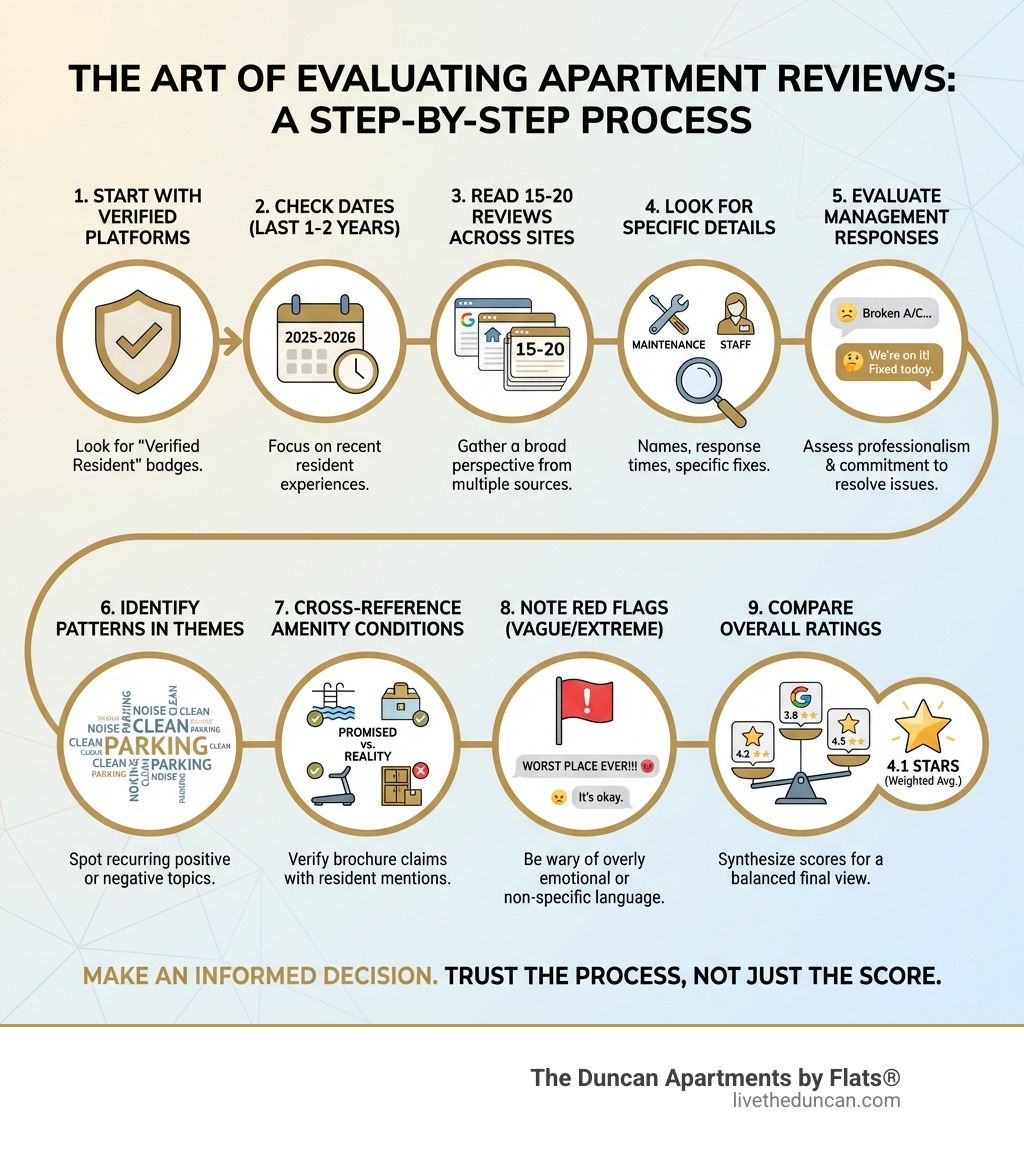
- Look for verified reviews - Reviews from actual residents (marked with badges like SatisFacts™) are more trustworthy than anonymous posts
- Focus on recent feedback - Reviews from the last 1-2 years reflect current management and conditions
- Read management responses - How staff replies to feedback shows their commitment to resident satisfaction
- Check multiple platforms - Compare reviews on Google, ApartmentRatings.com, and other sites for the full picture
- Spot the red flags - Watch for fake reviews with brochure-like language or extreme emotions without specific details
- Identify helpful details - The best reviews mention specific staff names, dates, maintenance response times, and amenity conditions
When you start your apartment search, you're probably going to read reviews. Everyone does. But here's the problem: not all reviews are created equal.
Some reviews come from actual residents who lived there for years. Others might be fake. Some focus on one bad experience from three years ago when different management ran the place. Others provide detailed, balanced feedback about current conditions.
The good news? With over 4 million renter reviews available online and platforms using verified survey systems, you have access to more authentic feedback than ever before. According to research from Cornell University's SC Johnson College of Business, there are actually more positive reviews online than negative ones, which means you're getting a fuller picture of the resident experience.
The challenge isn't finding reviews. It's knowing which ones to trust and how to read them correctly.
This guide will show you exactly how to separate helpful feedback from noise, spot fake reviews, understand what details actually matter, and use all that information to find an apartment community where you'll genuinely want to live.
Decoding the Details: What to Look for in a Helpful Review
When we dive into the vast ocean of apartment community reviews, our goal isn't just to skim the surface. We're looking for pearls of wisdom – those specific, actionable details that genuinely inform our decision-making. A review isn't helpful just because it has five stars; it's helpful because it provides a wealth of information that answers the key questions we have as apartment hunters.
What specific details should we look for? We want reviews that go beyond simple praise or complaints. Look for mentions of:
- Maintenance Staff & Service Request Timeliness: Are residents satisfied with the maintenance team? Do reviews mention staff hours, responsiveness, and their level of support? Are service requests completed in a timely manner? Reading about other residents' experiences with repairs can give us a clear picture of what to expect if something in our apartment needs attention. This is crucial for peace of mind.
- Management Helpfulness & Responsiveness: Is the management staff helpful and accommodating to residents? Reviews can guide us on how to prepare for the rental application process and describe the level of support provided by the management team. The epIQ Index, for example, gives a real-time look at whether a community's management team delivers an liftd customer experience and responds promptly to residents' needs, drawing from recent feedback. This kind of insight into management's approach to resident concerns is invaluable.
- Property Upkeep & Cleanliness: Is the area around the property consistently well-maintained? Reviews with photos can offer a more accurate depiction of the grounds than just website images. We also want to know about the cleanliness of common areas and the overall property.
- Amenity Quality & Upgrades: Does management continue to update and upgrade the community? Look for information regarding community events or activities provided by the building, in addition to details about amenity areas like fitness centers, pools, and shared lounges. Are these amenities well-maintained and functional?
- Neighborhood Desirability: Reviews often touch upon how residents perceive the neighborhood. For properties like The Duncan in Chicago's West Loop, reviews might discuss proximity to local attractions, dining, and transit.
The best reviews offer specificity, detailed grievances or praise, and even include names, dates, and locations where possible. This level of detail helps us understand the context of the feedback and assess its relevance to our own needs. For more insights into what residents are saying about communities in vibrant areas like ours, we encourage you to explore our West Loop Luxury Apartments Reviews.
The Anatomy of a Helpful Apartment Community Review
A truly helpful apartment community review acts like a detailed report from a trusted friend who has already lived there. It doesn't just say "good" or "bad"; it explains why. Here's what we look for:
- Detailed descriptions: Instead of "maintenance is slow," a helpful review might say, "My A/C broke on a Saturday, and it took until Tuesday for someone to come, despite multiple calls."
- Specific examples: "The gym equipment is often broken" is less useful than "The treadmill on the far left has been out of order for weeks, and the free weights are rarely re-racked."
- Mentions of dates: This helps us gauge the recency and relevance of the experience. "Last month, when I moved out..." or "In spring 2023, the pool was closed for a week..."
- Staff names (positive or negative): "Sarah in the leasing office was incredibly helpful during my move-in process" or "I had a frustrating interaction with a maintenance tech named John."
- Objective tone: While emotions are natural, reviews that stick to facts and specific observations, even when expressing frustration, are more credible.
- Balanced feedback: Even a negative review can be helpful if it acknowledges some positive aspects, showing the reviewer isn't just venting. Conversely, a positive review that mentions a minor drawback can feel more authentic.
Here's a list of key details to look for in a review:
- Maintenance response time
- Management communication and helpfulness
- Pest control mentions
- Noise levels (from neighbors, street, or common areas)
- Amenity upkeep and availability
- Cleanliness of common areas
- Move-in/move-out process experience
- Leasing office staff demeanor
- Safety and security observations
- Parking availability and issues
Verified vs. Unverified Reviews: Why It Matters
In online reviews, not all voices carry the same weight. This is where the distinction between verified and unverified reviews becomes incredibly important.
Verified reviews are those that have been confirmed to come from actual residents or prospects who have interacted directly with the apartment community. Platforms like ApartmentRatings.com, through partnerships with survey providers like SatisFacts™, collect these reviews by surveying residents directly. When you see a "Verified Badge" or similar indicator, it means the feedback is from someone who actually lives or has recently lived there. This matters immensely because it ensures the reviews are real, offering authentic insights into the resident experience. Communities participating in a Verified Resident Program are actively seeking transparent feedback, which speaks volumes about their commitment to resident satisfaction.
Unverified reviews, on the other hand, can be posted by anyone, often anonymously, without proof of residency or direct interaction with the property. While some unverified reviews might be genuine, they also open the door to less credible feedback. This could include reviews from disgruntled former residents with an axe to grind, competitors trying to tarnish a property's reputation, or even employees attempting to artificially inflate ratings.
Why does this distinction matter to us? Trust. When we're making a significant decision like choosing our next home, we need information we can rely on. Verified reviews provide a higher level of trustworthiness, giving us confidence that the experiences described are genuine. They help us cut through the noise and focus on real feedback from real people.
While we encourage you to look for verified sources, even unverified reviews can sometimes offer clues, but they should always be cross-referenced and viewed with a critical eye. To get a truly immersive and transparent view of a property, consider exploring our More info about our 360 Virtual Tours, which provide a verified look inside our community.
Spotting the Fakes: How to Identify Biased and Untrustworthy Apartment Community Reviews

The internet is a wonderful tool, but it's also a wild west of information, and apartment community reviews are no exception. While most people share their honest experiences, some reviews are intentionally misleading, designed either to boost a property or tear it down. Our mission is to become master detectives, capable of spotting these fakes and focusing on credible feedback.
How can we identify fake or biased reviews? It comes down to recognizing specific linguistic and behavioral patterns.
Fake positive reviews often sound too good to be true. Look for language that seems like it might be lifted directly from a brochure – generic praise, an overabundance of adjectives, and a lack of specific details. If a review gushes about "luxurious living" and "unparalleled amenities" without mentioning a single specific experience, person, or date, it might be a red flag. These could be written by employees of the apartment complex trying to promote it.
Fake negative reviews tend to swing to the other extreme. Be suspicious of inflammatory language about pests, terrible conditions, or overly vague complaints that play on emotions rather than facts. For instance, a review screaming "TERRIBLE MANAGEMENT, AVOID AT ALL COSTS!" without any specific examples of why the management is terrible, might be from a disgruntled former resident with an axe to grind or even a competing community trying to slander a property. According to a study completed by Cornell University’s SC Johnson College of Business, while there are more positive reviews overall, individuals tend to value negative reviews more, making them a powerful target for manipulation.
Reviews that are vague, overly emotional, or sound like marketing copy, whether positive or negative, should be viewed with skepticism. They lack the specificity and genuine experience that makes a review truly helpful.
Common Red Flags in Apartment Community Reviews
Becoming adept at identifying untrustworthy reviews is a critical skill for any apartment hunter. Here are some common red flags to watch out for:
- Overly positive or extremely negative language: If a review reads like a marketing ad ("paradise on earth!") or a furious rant ("worst place ever, don't walk, run!"), without any specific details to back it up, it's worth questioning. Extreme emotions are more likely to drive people to write reviews, but this doesn't always translate to helpful or balanced information.
- Lack of specifics: Genuine experiences are rich with detail. Fake reviews, especially positive ones, often use generic phrases and avoid mentioning names, dates, or particular incidents. If a review praises "amazing staff" but can't name a single person or describe a helpful interaction, it's suspect.
- Similar phrasing across multiple reviews: If you notice several reviews on different platforms using almost identical language or repeating specific unusual phrases, it could indicate a coordinated effort to manipulate ratings.
- Reviews posted in batches: A sudden influx of many five-star reviews or one-star reviews within a very short period might suggest artificial inflation or deflation of ratings.
- Profiles with only one review: While everyone starts somewhere, a profile that has only ever posted one glowing review for a specific property (or one scathing review for a competitor) could be a sign of a fake account.
- Vague complaints playing on emotions: As mentioned, reviews that leverage fear (e.g., "unsafe," "dirty") without providing concrete examples or dates are less reliable.
Our goal is to find accurate information to help us choose our next home in Chicago. By learning to spot these red flags, we can filter out the noise and focus on the genuine experiences of residents. For more practical advice on navigating your apartment search, check out our Chicago Apartment FAQs.
The Psychology of Reviewers
Understanding why people write reviews can help us interpret them more accurately. It's not always about objective reporting; often, it's about emotion.
People who have extreme emotions about something—whether exceptionally good or incredibly bad—are far more likely to write reviews. This means the online landscape can sometimes be skewed towards the poles of opinion. As a New York Times interview pointed out, most negative reviews are written "in the heat of the moment" and should be considered within the broader context of the situation. This doesn't mean they're untrue, but it suggests we shouldn't let a single, emotionally charged review overshadow dozens of balanced ones.
Interestingly, while there are statistically more positive reviews online, individuals tend to value negative reviews more. We're wired to look for potential problems, and a negative review can feel like a crucial warning. However, this tendency means we need to be extra diligent in evaluating negative feedback. Is it a legitimate concern, or an isolated incident fueled by a bad day? For example, if most residents praise the fitness center, but one person writes a negative review because they felt it wasn't clean enough that one time, we need to weigh that against the overall sentiment.
Our role as savvy apartment hunters is to look beyond the immediate emotion and seek out the underlying facts and patterns. This critical thinking helps us discern helpful feedback from mere venting or manipulation.
The Big Picture: A Strategic Approach to Evaluating Apartment Feedback

Reading individual apartment community reviews is just the first step. To truly understand a property, we need to zoom out and look at the "overall picture." This involves considering trends, timelines, and how management engages with feedback. It's like piecing together a puzzle, where each review is a fragment, and our job is to see the complete image.
When evaluating multiple reviews for a property, we should:
- Assess the overall sentiment: Do most reviews lean positive, negative, or neutral? Don't let one or two extreme opinions sway your judgment if the majority tells a different story.
- Check multiple review sites: Don't rely on just one platform. Cross-reference reviews on Google, Yelp, ApartmentRatings.com, and other relevant sites. If a consistent theme emerges across different platforms, it's likely more credible.
- Look at how reviews have changed over time: Are there noticeable shifts in sentiment? A property might have had issues two years ago but has since improved under new management or with significant upgrades.
- Consider management's responses: How management interacts with reviews, especially negative ones, offers a window into their customer service philosophy.
By taking this strategic approach, we move beyond individual anecdotes and gain a comprehensive understanding of what it's truly like to live in a particular community. This is especially important when considering dynamic neighborhoods like Chicago's West Loop, where properties are constantly evolving. For a look at some of the premier residences in this area, explore our Apartments in West Loop Chicago IL.
The Importance of a Review's Timeline
The timeline of a review is far more important than many realize. An old review, even if detailed, might be completely irrelevant to current conditions. Why? Because properties and their management can change significantly over time.
- Recency is key: We should prioritize reviews posted within the last year or two. These reflect the most current state of affairs regarding staff, maintenance, and community atmosphere. A review from three years ago about a noisy neighbor might be outdated if that neighbor has since moved.
- Outdated information: If an apartment was under different management when a review was written, or if major renovations or policy changes have occurred, that older review may no longer apply. For instance, negative reviews about an elevator posted three years ago might be irrelevant if positive reviews have surfaced recently, indicating improvements.
- Property improvements and changes: Properties often undergo upgrades to common areas, introduce new amenities, or change their service providers. An older review complaining about a lack of a modern fitness center would be outdated if the property has since installed one.
- Changes in management: Management teams can make or break a resident's experience. A glowing review from five years ago might reflect a completely different team than the one currently in place. Conversely, a string of negative reviews could be completely reversed by new, more responsive management.
While old reviews aren't entirely useless—they can sometimes highlight persistent structural issues, for example—we must always weigh them against more recent feedback. The current conditions and management are what will impact our daily lives. To see how our community is constantly evolving and improving, we invite you to View our Gallery.
What Management's Response Tells You
Beyond the content of the reviews themselves, pay close attention to how management responds (or doesn't respond) to feedback. This interaction is a powerful indicator of their customer service, professionalism, and overall commitment to their residents.
- Responsiveness: Does management reply to reviews in a timely manner? A quick, thoughtful response, especially to a negative review, suggests that they are attentive and value resident feedback. Companies that reply to a high percentage of negative reviews, such as one noted to reply to 84% of theirs, demonstrate a commitment to addressing concerns.
- Professionalism: Are the responses polite and constructive, even when dealing with criticism? Professional replies acknowledge the resident's experience without becoming defensive or dismissive.
- Problem-solving: Do their responses offer solutions or invite further discussion to resolve issues? This shows a proactive approach to management rather than just damage control. We pride ourselves on responding to our residents’ requests as quickly as possible and are eager to address any questions, concerns, or feedback they may have regarding our apartments.
- Acknowledging feedback: Even a simple "Thank you for your feedback" to a positive review shows appreciation. For negative feedback, an acknowledgment that they understand the concern and are looking into it is crucial.
- Customer service indicator: Management's online interaction is a mirror of how they might handle issues in person. If they are dismissive or unhelpful online, it's a strong sign that their in-person customer service might be similar.
Management's response to reviews is not just about reputation management; it's a direct reflection of their operational ethos. It tells us whether they genuinely care about creating a positive living environment and are willing to engage with residents to achieve it. Effective communication with apartment managers is crucial for ensuring our needs are met once we sign a lease. For more on this, consider reading How To Communicate with Managers at Your Apartment: A Review.
Frequently Asked Questions About Apartment Reviews
How important is the star rating versus the written content of a review?
Star ratings provide a quick overview, giving us an immediate sense of general satisfaction. For example, a 4.5-star average might suggest a well-regarded community. However, the written content offers crucial context and specific details about the resident's actual experience. A 3-star review with detailed, balanced feedback about maintenance response times or specific amenities can be far more helpful than a 5-star review that just says "It's great!" without any elaboration. We should always prioritize the qualitative details in the text, as they reveal the "why" behind the rating. The written content helps us understand if the issues or praises are relevant to our own priorities.
How many reviews should I read before making a decision?
There's no magic number, but we should aim to read enough reviews across multiple platforms to identify patterns and get a balanced view. A good starting point is to read at least 15-20 of the most recent reviews from the last 1-2 years. This allows us to see consistent praise or complaints, which are often more reliable than isolated incidents. Beyond that, we can continue reading until we feel we have a comprehensive understanding of the community's strengths and weaknesses, specifically looking for answers to our own key questions about living there.
Can I trust reviews on the apartment community's own website?
Reviews on an apartment community's own website can be helpful, but they should always be viewed with a degree of skepticism. These reviews are often curated, meaning the property management may choose which reviews to display, potentially highlighting positive ones and omitting negative ones. While they can offer valuable insights and sometimes feature verified testimonials, it's a best practice to cross-reference them with reviews on independent, third-party sites like Google, Yelp, and ApartmentRatings.com. By comparing feedback across multiple platforms, we can get a more complete and unbiased picture of resident satisfaction, ensuring we're not just seeing a selectively positive portrayal.
Conclusion: From Reviews to Your New Reality
Navigating apartment community reviews can feel like a complex task, but with the right approach, it becomes our most powerful ally in finding the perfect home. We've learned that not all reviews are created equal, and our ability to discern the genuine from the fake, the helpful from the emotional, is paramount.
The key takeaways for us as renters when using online reviews are:
- Prioritize Verified Feedback: Seek out reviews from platforms that verify residents, like those using SatisFacts™ surveys. These offer the most authentic insights.
- Focus on Specifics: Look beyond star ratings for detailed narratives that mention maintenance, management, amenities, and specific experiences.
- Be a Detective: Learn to spot red flags like overly generic praise, inflammatory language, and suspicious posting patterns that indicate fake or biased reviews.
- Consider the Timeline: Recent reviews are more relevant. Old reviews might not reflect current conditions or management.
- Evaluate Management's Engagement: How a property's management responds to reviews tells us a lot about their customer service and commitment to residents.
- Look at the Overall Picture: Don't rely on a single review. Cross-reference across multiple platforms and identify consistent themes to get a balanced perspective.
The main benefits of reading apartment community reviews are clear: they empower us to make informed decisions, hold apartment owners accountable for promised services, and ultimately, help us find a community where we can thrive. They provide a window into the day-to-day reality of living somewhere, far beyond what brochures or tours can convey alone.
At The Duncan, we understand the importance of genuine resident feedback and strive to create a living experience that consistently earns high praise. Our modern, stylish apartments in Chicago's West Loop, with spacious floor plans and luxury amenities like an indoor pool and rooftop lounge, are designed for an liftd lifestyle. We believe in combining comfort, convenience, and a prime location near top city attractions.
By diligently applying these strategies, we can move from simply reading reviews to making an educated, confident choice about our new home. We encourage you to use these insights as you explore your options, and when you're ready to experience the difference firsthand, we invite you to Schedule a Tour to see our community. You can also review what residents are saying about us on our West Loop Luxury Apartments Reviews.


