


What You Need to Know About Chicago Housing Programs
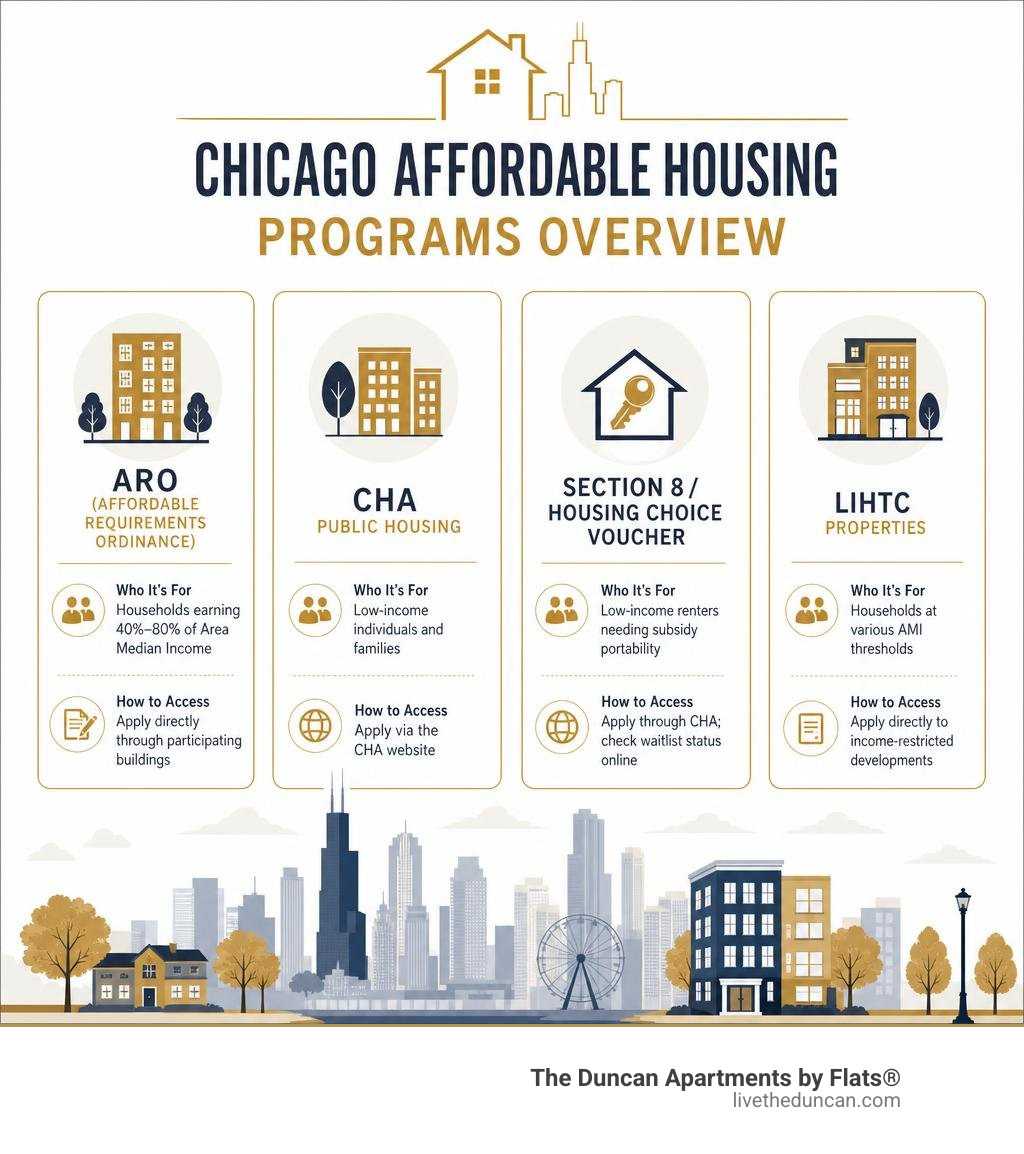
Chicago housing programs give qualifying renters access to units across the city. Here's a quick overview of the main options:
| Program | Who It's For | How to Access |
|---|---|---|
| ARO | Qualifying households | Apply directly through participating buildings |
| CHA Public Housing | Eligible individuals and families | Apply via the CHA website |
| Section 8 / Housing Choice Voucher | Renters needing housing assistance | Apply through CHA; check waitlist status online |
| LIHTC Properties | Households meeting program guidelines | Apply directly to participating developments |
Finding a place to live in Chicago has changed over the past decade. The distribution of rental units has shifted since 2012.
The city is responding. In 2025, Chicago supported 15 housing developments — creating or preserving over 1,100 units. Projects are spread across neighborhoods from Pilsen to West Garfield Park to the South Loop.
This guide breaks down how Chicago's housing programs work, who qualifies, where new units are being built, and how to navigate the process — whether you're looking for a CHA voucher, an ARO unit, or a designated apartment in a new development.
Understanding Chicago Housing Programs
Navigating the landscape of municipal housing programs can feel overwhelming. To find the right path, it helps to understand how the city defines eligibility.
The foundation of almost every housing assistance program in Chicago is based on household size and specific program guidelines. Calculated annually by the U.S. Department of Housing and Urban Development (HUD), these guidelines help determine eligibility for various programs.
To help residents identify which developments match their household size, the Chicago Department of Housing maintains the Rental Housing Resource List - City of Chicago. This resource lists city-supported properties across all 77 community areas. Understanding these basic metrics is the first step when utilizing a comprehensive Chicago Apartments for Rent Guide to find your next home.
The Requirements Ordinance (ARO) and Chicago Housing
The Requirements Ordinance (ARO) is one of the city's primary tools for integrating designated units into rapidly developing neighborhoods. When developers build new residential properties with 10 or more units that require a zoning change, receive city land, or utilize financial assistance from the city, they must designate a specific percentage of the units for participating households.
A companion program, the Special Assessment Program (AHSAP), provides property tax incentives to developers who commit to preserving or creating designated units in areas like Fulton Market and the West Loop.
These programs ensure that as new developments rise, a portion of the building remains accessible to qualifying households. These units feature the exact same high-quality finishes, appliances, and access to building amenities as other units. When renting one of these apartments, tenants sign a standard lease agreement that complies with the city's strict tenant protections, which you can read about in our guide to the Chicago Apartment Lease Agreement.
Chicago Housing Authority (CHA) and Voucher Programs
The Chicago Housing Authority (CHA) is the second-largest public housing agency in the nation, serving more than 135,000 residents across all 77 Chicago community areas. CHA administers two primary types of assistance:
- Public Housing Portfolios: Traditional buildings and scattered-site properties owned and managed directly by the CHA.
- Housing Choice Vouchers (Section 8): A tenant-based program that allows voucher holders to find their own housing in the private market.
To explore these options, check current waitlists, or learn about landlord participation, visit the Chicago Housing Authority: Homepage. Because voucher waitlists open infrequently due to high demand, applicants are encouraged to monitor the CHA portal regularly to update their contact information and track their status.
Current Trends in the Chicago Rental Market
The Chicago housing landscape has shifted dramatically over the last decade. While the city has experienced a construction boom in certain sectors, the overall supply of rental housing has changed in ways that present unique challenges for renters.
According to data tracking housing stock changes between 2012 and 2023, Chicago saw a significant decline in smaller, multi-unit buildings (such as classic two-flats and four-flats) which historically provided traditional neighborhood housing. Conversely, there was a massive increase in large, corporate-managed multifamily properties.
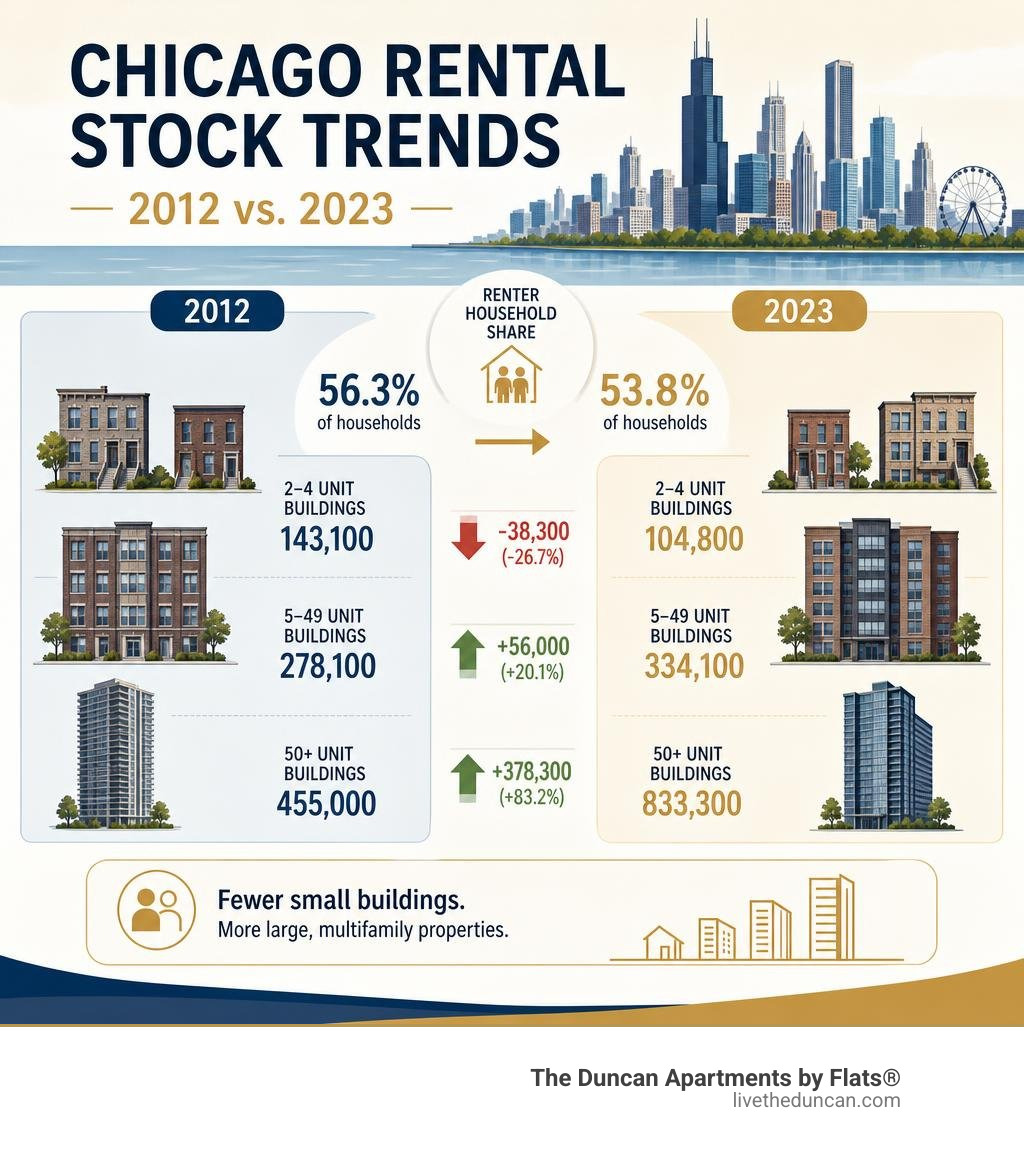
The following table highlights how the city's housing stock transformed over this eleven-year period:
| Building Size / Metric | 2012 Status | 2023 Status | Net Change |
|---|---|---|---|
| Renter Household Share | 56.3% of households | 53.8% of households | -2.5% |
| Units in 2-4 Unit Buildings | High concentration | -28,000 units | -12% (approx.) |
| Units in Large Multifamily (50+) | Moderate concentration | +73,000 units | +28% (approx.) |
These structural shifts have altered the dynamics of the Chicago Rental Market Trends, driving demand toward larger buildings while reducing the availability of traditional neighborhood options. To understand how these changes impact local occupancy, you can review our analysis of the Chicago Apartment Rental Market.
Supply and Demand Dynamics in Chicago Housing
The core challenge facing Chicago renters is a shift in the available rental inventory.
Roughly 78% of all new multifamily construction has occurred in high-demand neighborhoods, leaving renters with fewer options in their historical communities.
To search for private-market properties that actively accept housing vouchers or participate in localized programs, renters can utilize platforms like Rental Properties in Chicago, IL, which currently lists over 7,000 rental properties in the Chicago area.
New Developments and Funding Initiatives
To address the housing shortage, the Chicago Department of Housing utilizes its Qualified Allocation Plan (QAP) to direct resources toward high-impact developments. Through the QAP, the city allocates federal Housing Tax Credits (LIHTC), Tax Increment Financing (TIF) districts, and municipal housing bonds.
In a major development push, the city backed 15 major housing projects. This initiative will create or preserve 1,223 total units, of which 1,164 are dedicated as program-specific units.
These projects prioritize Equitable Transit-Oriented Development (eTOD), ensuring that residents live within walking distance of CTA train stations and bus lines. To read more about the scope of these municipal investments, see the report on how Chicago commits to 15 housing projects, adding over 1,100 units | Chicago Construction News.
Key Neighborhood Projects and Community Impact
These city-backed developments are strategically distributed across several neighborhoods to prevent displacement and offer long-term residential options:
- Pilsen: The Resurrection Project is developing a 76-unit building on a long-vacant industrial lot. The project represents a major community victory after more than 20 years of local advocacy. It will feature a ground-floor early childhood center. To learn more about this project, read about The Resurrection Project Bringing Housing To Vacant Pilsen Lot.
- West Garfield Park: Ground has broken on C.A.R.E. Manor, a 44-unit development. The building, located near the CTA Green Line, will offer family-sized two- and three-bedroom units alongside on-site social services like a food pantry, adult literacy classes, and GED training. Every unit is designed to be convertible to full ADA accessibility. For a deeper look, check out the article on how C.A.R.E Manor, A 44-Unit Apartment Complex, Breaks Ground In Garfield Park.
- South Loop: The Southbridge development is transforming the historic site of the former Harold Ickes Homes public housing complex into a mixed-income community. Phase 3 of the project will add 80 apartments, including 29 CHA units and 44 designated units, creating a connected, transit-friendly environment near the Green Line.
Frequently Asked Questions about Chicago Housing
Navigating application processes and program guidelines can raise many questions. Below are answers to some of the most common inquiries regarding Chicago’s housing programs.
How do I apply for the ARO program in Chicago?
Unlike public housing, there is no centralized waitlist for the ARO program. Instead, individual developers manage the leasing and intake for the designated units within their properties.
To apply, you must contact the leasing office of a participating building directly. The leasing team will guide you through the process, which includes a detailed application and strict third-party eligibility verification. You will need to provide standard documentation. For general leasing tips and standard documentation requirements, browse our Chicago Apartment FAQs.
What is the difference between Section 8 and ARO?
While both programs help renters access quality housing, they operate differently:
- Section 8 (Housing Choice Vouchers): This is a federal program tied to the renter. If you receive a voucher, you can take it to any private landlord who accepts Section 8.
- ARO (Requirements Ordinance): This program is tied directly to the building. You must meet the specific program guidelines for that apartment, and the designation does not move with you if you relocate.
For a broader overview of navigating the local rental market under different programs, refer to our Apartments for Rent in Chicago Guide.
How is eligibility calculated for Chicago housing programs?
Eligibility guidelines are determined by HUD and updated annually, typically taking effect on May 1st. They are based on household size and specific program criteria.
Conclusion
The Chicago housing landscape continues to evolve through innovative municipal policies, community-led advocacy, and private-public partnerships. As neighborhoods like the West Loop grow, programs like the ARO ensure that diverse residential options remain integrated into the fabric of our city's most dynamic commercial and cultural hubs.
At The Duncan, we offer modern, stylish apartments in Chicago's West Loop, featuring spacious floor plans and premium amenities like an indoor pool and rooftop lounge. We are proud to support balanced, inclusive development in our community. If you are looking to call the West Loop home, we invite you to explore our community and learn more about our participating housing layouts by visiting The Duncan ARO Plans.


