


What Chicago Renters Rights Mean for You
Chicago renters rights are among the strongest tenant protections in the United States — and if you live in the city, they apply to you right now.
More than half of Chicago residents rent their homes. That's over 600,000 renter households protected by a detailed local law called the Chicago Residential Landlord and Tenant Ordinance (RLTO). This ordinance sets clear rules for both landlords and tenants — and unlike many lease terms, it cannot be signed away.
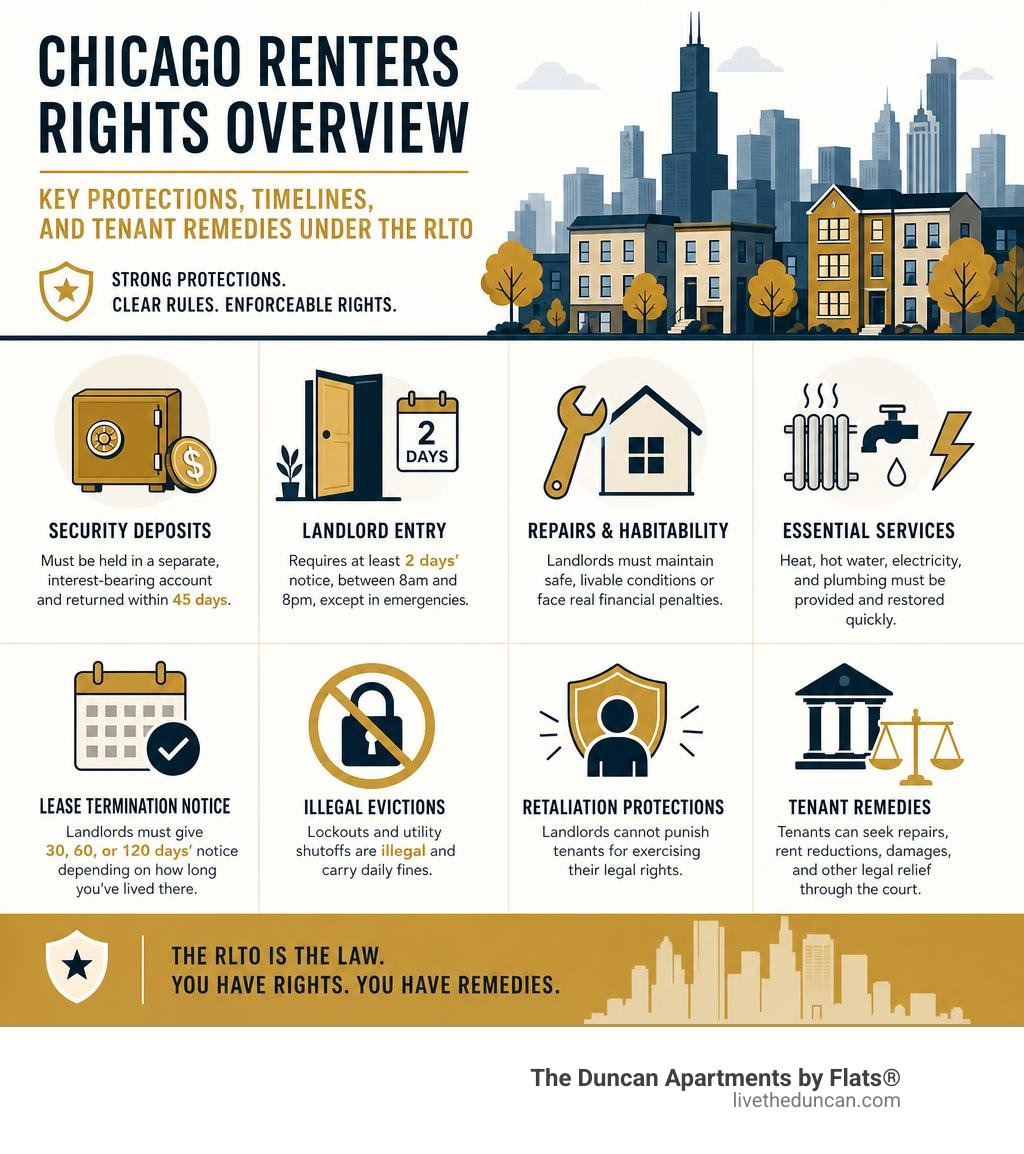
Here's a quick overview of what Chicago renters rights cover:
- Security deposits — must be held in a separate, interest-bearing account and returned within 45 days
- Landlord entry — requires at least 2 days' notice, between 8am and 8pm, except in emergencies
- Repairs and habitability — landlords must maintain safe, livable conditions or face real financial penalties
- Essential services — heat, hot water, electricity, and plumbing must be provided and restored quickly
- Lease termination notice — landlords must give 30, 60, or 120 days' notice depending on how long you've lived there
- Illegal evictions — lockouts and utility shutoffs are illegal and carry daily fines
- Retaliation protections — landlords cannot punish tenants for exercising their legal rights
These aren't just guidelines. They're enforceable laws with specific timelines, dollar amounts, and remedies.
This guide breaks down everything you need to know — from move-in documentation to what happens if your landlord ignores a repair request.
Understanding the Chicago RLTO and Party Responsibilities
The Chicago Residential Landlord and Tenant Ordinance (RLTO) is the legal backbone of chicago renters rights. It governs almost every residential lease agreement signed within city limits. However, before you attempt to enforce your rights, you must first determine if your building is covered.
Which Rental Units Are Covered by the RLTO?
The RLTO applies to the vast majority of the city's 500,000+ rental units, whether your lease is written or oral. However, there are a few notable exclusions. The ordinance does not cover:
- Owner-occupied buildings containing six or fewer units
- Student housing, dormitories, or shelters supervised by an institution
- Transient facilities like hotels and motels (unless you reside there for more than 32 consecutive days on a monthly rental basis)
- Employee housing provided by an employer
- Cooperative apartments where the tenant is a shareholder
For those living in owner-occupied buildings with six or fewer units, state and federal laws still apply, but the specific, strict remedies of the RLTO do not. If you live in a larger, professionally managed building, you are fully protected.
Tenant Duties Under Chicago Law
While chicago renters rights are robust, they come with clear tenant responsibilities. To remain in compliance with the law and protect your rights, you must:
- Pay your rent on time and in full.
- Keep your apartment clean and safe.
- Properly dispose of all garbage and recyclable materials.
- Maintain the batteries in your smoke and carbon monoxide detectors, testing them regularly.
- Use all plumbing, electrical, heating, and cooling systems in a reasonable manner.
- Avoid intentionally or negligently damaging the property.
- Respect your neighbors by keeping noise levels reasonable and using shared spaces courteously.
Before moving in, it is highly recommended to document the condition of the apartment with photos and a written checklist to prevent disputes when you eventually move out.
Landlord Duties Under Chicago Law
Landlords are legally obligated to provide a property that meets all local building codes and habitability standards. Under the Chicago Residential Landlord Tenant Ordinance, a landlord must:
- Maintain structural integrity, plumbing, electrical, and heating systems.
- Provide a summary of the RLTO attached to every written lease agreement.
- Provide written disclosure of the owner's or manager's contact information.
- Disclose any building code violations cited by the city in the previous 12 months, as well as any pending utility shutoff notices.
- Allow tenants to sublet the apartment, making a good-faith effort to mitigate damages if a tenant must break their lease early. Landlords cannot charge additional fees for subletting.

Understanding these mutual obligations is the first step toward a smooth rental experience. If you are currently searching for a new home, reviewing our Apartments for Rent Chicago Guide and checking our Chicago Apartment FAQs can help you navigate the process with confidence.
Key Protections Under Chicago Renters Rights
The RLTO is designed to balance the power dynamic between landlords and tenants. To understand your options under the law, it helps to read a comprehensive Chicago Tenants' Rights Guide to see how these protections apply in real-world scenarios. Two of the most common areas of friction involve security deposits and landlord entry.
Security Deposit Rules and Chicago Renters Rights
Security deposit violations are among the most heavily penalized infractions under Chicago law. If a landlord collects a security deposit, they must follow incredibly strict guidelines:
- Escrow Accounts: The deposit must be held in a federally insured, interest-bearing account in an Illinois financial institution. It cannot be commingled with the landlord’s personal assets.
- Receipts: The landlord must provide a written receipt at the time the deposit is received, detailing the amount, the date, the name of the bank, and the signature of the person receiving it.
- Interest Payments: For deposits held longer than six months, landlords must pay annual interest. The interest rate is calculated annually by the City Comptroller. This interest must be paid to the tenant or credited toward rent within 30 days of each 12-month rental period.
- The 45-Day Return Timeline: When you move out, the landlord has exactly 45 days to return your security deposit plus any accrued interest.
- Itemized Deductions: If the landlord deducts money for property damage, they must provide an itemized statement of the damages, along with actual receipts or estimates, within 30 days of you vacating the unit. They cannot deduct for normal wear and tear.
If a landlord violates any of these rules, the tenant is entitled to recover damages equal to twice the security deposit, plus the return of the deposit itself, interest, and court costs. Because of these strict rules, many property owners now charge a non-refundable move-in fee instead of a security deposit. Make sure you review your Chicago Apartment Lease Agreement to understand exactly what fees you are paying.
Landlord Entry Limits and Chicago Renters Rights
Your home is your sanctuary, and Chicago law protects your right to privacy. A landlord cannot enter your apartment whenever they please.
- Required Notice: Landlords must give you at least two days' notice (48 hours) before entering your unit.
- Permitted Hours: Entry must occur between 8:00 AM and 8:00 PM, unless you agree otherwise.
- Permitted Reasons: Landlords can only enter to inspect the premises, make necessary repairs, supply essential services, or show the unit to prospective buyers or tenants.
- Emergency Exception: A landlord may enter without notice only in cases of emergency or practical necessity (such as a burst pipe flooding the unit below). However, they must notify you of the entry within two days after it occurs.
If a landlord enters without permission, makes unreasonable demands for entry, or uses their access to harass you, you can seek injunctive relief, terminate the lease, or recover damages equal to one month's rent or twice your actual financial losses, whichever is greater.
Tenant Remedies, Evictions, and Proposed Protections in 2026
When a landlord fails to maintain a property or violates the lease, Chicago renters have several powerful legal remedies. However, exercising these remedies requires strict adherence to legal procedures.
Repair and Deduct vs. Lease Termination
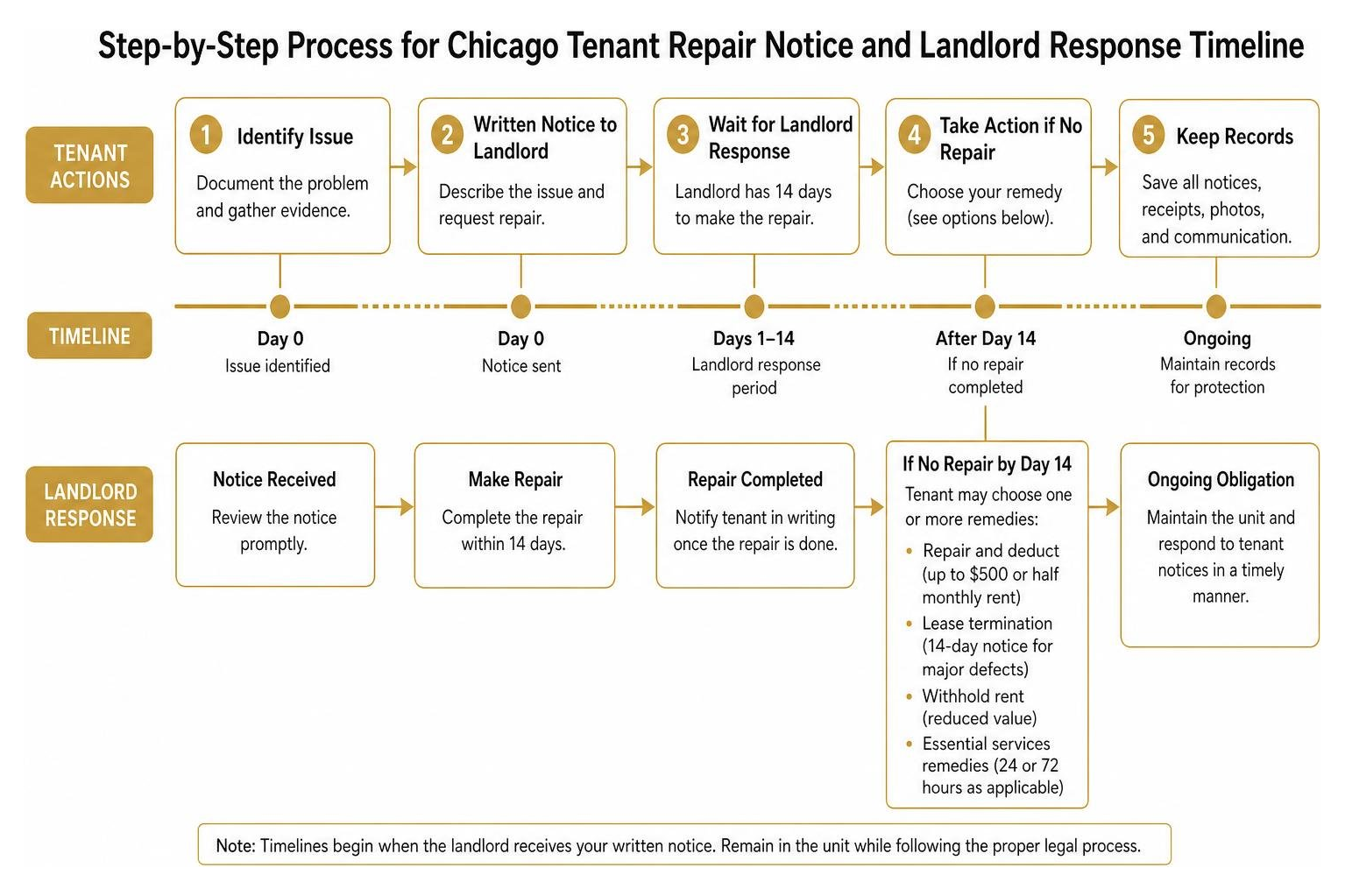
If your apartment has code violations or maintenance issues, you must first notify your landlord in writing.
- Minor Defects (Under $500 or Half Monthly Rent): If the landlord fails to make repairs within 14 days of receiving your written notice, you can hire a professional to make the repair, submit the receipt to your landlord, and deduct the cost (up to $500 or half a month's rent, whichever is greater) from your next rent payment.
- Major Defects: If the issue is severe and affects habitability, you can send a 14-day written notice stating that you will terminate your lease and move out if the issue is not resolved. If they fail to fix it, the lease is broken, and they must return your prepaid rent and security deposit.
- Rent Withholding: If a landlord fails to maintain the unit, tenants can withhold a portion of the rent that reflects the reduced value of the apartment. Warning: Rent withholding carries risks. Landlords often respond by filing for eviction, and eviction cases in Cook County move nearly 10 times faster than housing code enforcement cases. Always consult legal aid and keep withheld rent in a separate bank account to prove your good-faith intent.
Essential Services and Temperature Ordinances
Essential services include heat, hot water, running water, electricity, gas, and plumbing. If these are cut off, you must give written notice. If the landlord fails to act within 24 hours (or 72 hours for certain complex issues), you can procure substitute services and deduct the cost from rent, sue for damages, or move to substitute housing and deduct the cost from your rent.
Chicago also has strict temperature rules:
- The Heat Ordinance (September 15 to June 1): Landlords must keep residential units at a minimum of 68 degrees during the day (8:30 AM to 10:30 PM) and 66 degrees at night.
- The Cooling Ordinance: Certain larger residential buildings must provide air conditioning or a cooling center when outdoor temperatures exceed extreme thresholds.
Eviction Protections and the Fair Notice Ordinance
Landlords cannot simply kick you out or change your locks. The eviction process must go through the Cook County court system. Under the Fair Notice Ordinance, landlords must provide tiered written notice if they intend to raise your rent or choose not to renew your lease:
- 30 days of notice if you have lived in the unit for less than 6 months.
- 60 days of notice if you have lived in the unit for 6 months to 3 years.
- 120 days of notice if you have lived in the unit for more than 3 years.
Additionally, tenants have a one-time right to cure nonpayment of rent by paying all back rent and court fees before an order of possession is issued by a judge.
If a landlord attempts an illegal lockout (changing locks, removing doors, or shutting off utilities), they face daily fines of $200 to $500, and you can recover up to two months' rent or twice your actual damages. Landlords are also strictly prohibited from retaliating (raising rent, cutting services, or threatening eviction) because you complained to the city or joined a tenant union.
Proposed Protections: Mayor Johnson’s Protecting Renters Ordinance
As of July 2026, the city is actively debating Mayor Brandon Johnson’s proposed Protecting Renters Ordinance. This sweeping proposal aims to update the 40-year-old RLTO by:
- Banning hidden application and processing fees.
- Creating a comprehensive citywide rental registry to track the ownership and code violations of the city's 500,000+ rental units. This registry would charge landlords an annual fee of $20 to $60 per unit (exempting small, owner-occupied 2-to-6 unit buildings) to fund tenant services.
- Establishing a "Just Cause" eviction standard, requiring landlords to provide relocation assistance for no-fault evictions.
For more information on navigating local rental dynamics, consult our West Loop Apartments Rental Guide 2026.
| Repair Level | Notice Required | Maximum Remedy |
|---|---|---|
| Minor Repair | 14 days (written) | Repair & deduct up to $500 or 1/2 month's rent |
| Major Repair | 14 days (written) | Lease termination & full deposit refund |
| Essential Service | 24 hours (written) | Withhold rent, sue, or procure substitute housing |
Frequently Asked Questions About Chicago Rental Laws
Can a landlord raise my rent without notice in Chicago?
No. Under the Fair Notice Ordinance, your landlord must provide written notice of any rent increase. The amount of notice required depends on your tenancy length: 30 days for under 6 months, 60 days for 6 months to 3 years, and 120 days for more than 3 years. If they fail to give proper notice, you are legally entitled to remain in the unit at your current rent rate for the duration of the required notice period.
What lease terms are prohibited under the RLTO?
Any lease clause that conflicts with the RLTO is completely unenforceable. Prohibited terms include:
- Agreements to waive your rights under the RLTO.
- Clauses limiting the landlord's liability or requiring you to pay their attorney fees.
- Agreements to waive a jury trial.
- Late fee provisions that exceed city caps. Late fees are capped at $10 per month for rent under $500, plus 5% per month on any portion of rent exceeding $500.
How can I contact the Chicago Renters’ Rights Hotline?
If you need immediate assistance or advice, you can access several local resources:
- City Renters’ Rights Hotline: Call 312-742-RENT (7368) to speak with representatives from the Department of Housing.
- Metropolitan Tenants Organization (MTO): Call their free hotline at 773-292-4988 (Monday through Friday, 1:00 PM to 5:00 PM).
Your Next Steps in West Loop Living
Knowing your chicago renters rights is key to a comfortable, stress-free renting experience. At The Duncan, we believe that transparency, respect, and high-quality management are essential parts of modern urban living.
Located in the heart of Chicago's vibrant West Loop, our community combines stylish, modern apartments with unmatched amenities, including an indoor pool, a fully equipped fitness center, and a beautiful rooftop lounge with skyline views. We prioritize clear communication, professional maintenance, and full compliance with all local housing laws so you can focus on enjoying everything our neighborhood has to offer.
If you are ready to experience hassle-free rental living in the West Loop, explore our available apartments or review our standard Chicago Apartment Lease Agreement to see how we put resident respect first.


