


Why the West Loop is Chicago’s Most Dynamic Neighborhood
The west loop is Chicago's premier hub for world-class dining, historic architecture, and modern city living. It offers a perfect mix of industrial charm and modern luxury, making it one of the most sought-after areas in the country.
Here is a quick snapshot of what defines this dynamic area:
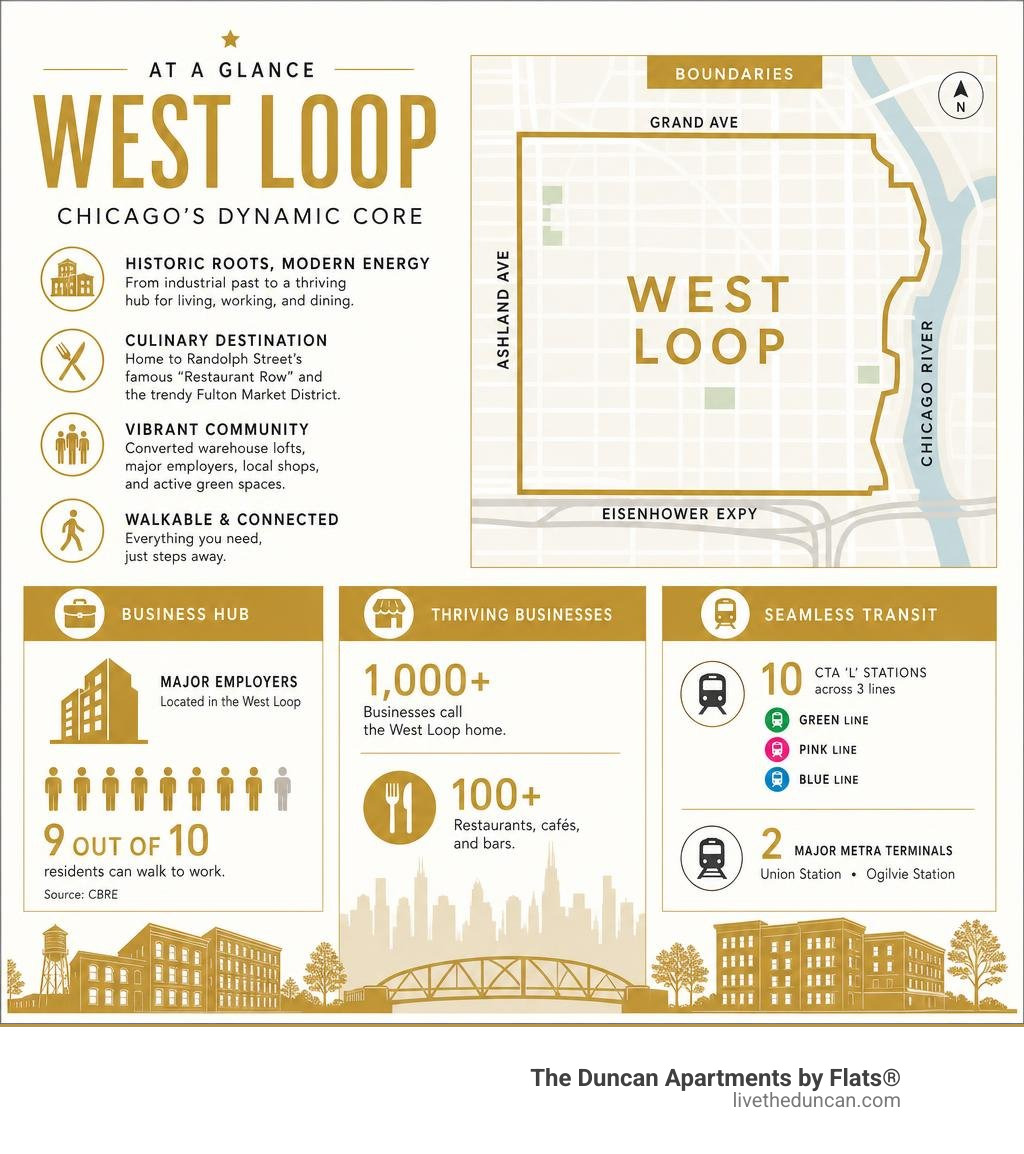
- Geographic Boundaries: Bounded by Grand Avenue to the north, Ashland Avenue to the west, the Eisenhower Expressway to the south, and the Chicago River to the east.
- Culinary Fame: Home to Randolph Street's famous "Restaurant Row" and the trendy Fulton Market District.
- Seamless Transit: Served by 10 CTA 'L' stations across three lines (Green, Pink, and Blue) and two major Metra terminals (Union Station and Ogilvie).
- Vibrant Vibe: A busy community featuring converted warehouse lofts, major corporate offices like Google and McDonald's, and active green spaces.
In the past, this area was a busy hub for meatpacking and manufacturing. Today, those historic brick warehouses have found new life. They now house award-winning restaurants, creative offices, and luxury apartments.
For urban professionals, this neighborhood offers a rare balance. You can walk to your office in the Loop, grab a famous burger on your lunch break, and relax in a local park with your dog, all within a few blocks. It is a place where industrial history meets modern convenience.
The Rich History and Boundaries of the West Loop
To truly understand the modern energy of the west loop, we have to look back at its gritty, hardworking past. Long before it was filled with boutique design spaces and high-end dining, this area was the literal engine room of Chicago.
In the 19th and early 20th centuries, the neighborhood functioned as the city's primary manufacturing, railroad, and meatpacking hub. The streets were filled with horse-drawn carts, wholesale produce merchants, and the heavy aroma of industrial factories. It was a place of pure utility, characterized by sturdy brick warehouses designed to withstand heavy machinery and massive inventories.
By the mid-20th century, however, industrial patterns shifted. Many of the manufacturing operations moved outward, leaving behind a landscape of quiet, underutilized warehouses. In fact, back in 1949, Time Magazine went so far as to describe the area as "the land of the living dead." The Madison Street corridor, which we now know as a bustling avenue of local boutiques and cafes, was once lined with transient flop houses and industrial ruins.
The turning point came in the late 20th and early 21st centuries. Artists, developers, and culinary pioneers looked at the empty factories and saw limitless potential. The very features that made these buildings great for manufacturing—soaring timber ceilings, exposed brick walls, massive factory-sized windows, and open floor plans—made them perfect for creative loft conversions.
Today, the neighborhood is officially part of the Near West Side, Chicago community area. Its boundaries are defined by:
- Grand Avenue to the north
- The Eisenhower Expressway (I-290) to the south
- The Chicago River to the east
- Ashland Avenue to the west

This geographical footprint has experienced a massive population boom. The local resident count grew from a modest 10,000 to 15,000 residents in the 1960s and 1970s to nearly 33,000 residents today. Looking at the broader Near West Side, the population jumped from 54,881 in 2010 to 67,881 in 2020—a remarkable 23.7% increase.
This residential surge has been matched by corporate interest. Between 2010 and 2017 alone, more than 40 major corporations requiring large commercial footprints moved into the neighborhood. Today, the area serves as a major commercial powerhouse. Google’s massive Chicago headquarters occupies 535,000 square feet at 1K Fulton, while McDonald’s global headquarters spans 485,000 square feet on the former site of Oprah Winfrey’s historic Harpo Studios.
Navigating the West Loop: Transit and Accessibility
One of the greatest advantages of living in or visiting the neighborhood is its unparalleled transit connectivity. Whether you are commuting to the downtown business district or heading out to the suburbs, getting around is incredibly simple.
The neighborhood is served by 10 CTA "L" stations across three transit lines:
- The Green and Pink Lines run directly through the heart of the neighborhood, with key stops at Morgan, Clinton, and Ashland–Lake.
- The Blue Line runs along the southern edge, with convenient stations at Clinton and UIC–Halsted, offering direct access to O'Hare International Airport.
For those traveling from the suburbs or outside the city, the eastern edge of the neighborhood is anchored by two major commuter rail terminals: Union Station (serving Metra and Amtrak) and the Ogilvie Transportation Center.
With wide, pedestrian-friendly sidewalks and a highly organized street grid, the neighborhood is also a dream for walkers. Most of the top local spots are located within a half-mile of an "L" station. For real-time transit updates, local business listings, and custom neighborhood maps, you can consult the West Loop Chicago: Map, Events, Guides · WLV platform to plan your route.
Sub-Neighborhoods, Cultural Landmarks, and the Culinary Scene
While the neighborhood is often talked about as a single entity, it is actually a rich tapestry of distinct sub-neighborhoods, each offering its own unique personality and history.
On the eastern edge, close to the river, lies West Loop Gate, historically known as the gateway between the West Side and downtown. Further north is the Fulton River District, an area once defined by the sweet, rich aroma of chocolate from the historic Blommer Chocolate Company factory, which operated as a sensory landmark for decades before closing its doors in 2024.
Walking south, you will encounter the historic Jackson Boulevard Historic District, a beautifully preserved enclave featuring elegant brick and stone row houses dating back to the 1880s and 1890s. This quiet, tree-lined stretch offers a striking contrast to the industrial lofts just a few blocks away.
Further west along Halsted Street is Greektown, a vibrant cultural enclave that has anchored Greek-American culture in Chicago since the mid-20th century. While many Greek-American families have moved to the suburbs over the decades, Greektown remains a lively destination for traditional dining, bakeries, and cultural education. It is home to the National Hellenic Museum, the second-oldest American institution dedicated to preserving and celebrating Greek culture.
The neighborhood is also packed with immersive arts and entertainment. The WNDR Museum offers interactive, tech-forward art installations that challenge your senses. For live music, theater, and visual arts, the Epiphany Center for the Arts—housed in a beautifully restored historic church—serves as a premier cultural hub. And, of course, the massive United Center sits just to the west, hosting global concert tours and serving as the home turf for the Chicago Bulls and Chicago Blackhawks. To explore more of these local landmarks, take a look at our guide to West Loop Chicago Attractions.
Sub-Neighborhoods and Parks
Despite its industrial roots, our neighborhood boasts some of the most innovative and active green spaces in the city. These parks serve as crucial community gathering spots where neighbors meet, exercise, and play.
- Mary Bartelme Park: Spanning 2.71 acres, this award-winning park is a masterpiece of modern urban design. It features a fantastic children's play area, a dedicated dog park, and a series of architectural steel gates that release a cool mist during warm summer days.
- Skinner Park: A beloved neighborhood hub that features a community garden, sports fields, and a modern playground. It sits adjacent to Skinner Elementary School, one of the top-performing public schools in the city.
- Union Park: The largest park in the area at 13 acres, Union Park features tennis courts, basketball courts, a swimming pool, and a historic fieldhouse. It also serves as the green backdrop for major summer music festivals.
(Please note: For those moving to the area with four-legged companions, our local residential buildings gladly welcome up to two pets per apartment, making it easy to enjoy these fantastic local dog parks with your furry friends.)
Restaurant Row and Fulton Market Dining
You cannot talk about the neighborhood without talking about food. This area is widely recognized as a global culinary destination, drawing food lovers from all over the world.
The culinary action is concentrated in two primary zones: Restaurant Row along Randolph Street and the historic streets of the Fulton Market District. Here, historic meatpacking houses have been transformed into sleek, stylish dining rooms.
If you are planning a culinary tour, here are a few legendary spots you cannot miss:
- Au Cheval: Famous for serving what many critics call the absolute best burger in the country. Be prepared for a wait, but you can always grab a drink next door while you wait for your table.
- Girl & The Goat: Helmed by a premier local chef, this spot serves bold, globally-inspired shared plates that have defined the neighborhood's dining scene for years.
- Green Street Smoked Meats: Tucked down a brick alleyway, this popular spot serves up incredible Texas-style barbecue under a canopy of twinkling lights.
For morning favorites, cozy coffee shops, and weekend mid-day dining, check out our curated list of the best West Loop Brunch Spots. And if you are looking for late-night bites, craft cocktail lounges, or cozy neighborhood taverns after the sun goes down, our West Loop Late Night Guide 2026 has you covered.
Every summer, the neighborhood celebrates this rich culinary heritage with the Taste of Randolph Street. Hosted by the West Loop Community Organization for over 26 years, this massive three-day street festival brings together the area's best restaurants, live music acts, and over 100,000 visitors for an unforgettable weekend.
Living in the Neighborhood: Real Estate and Lifestyle
Living in this neighborhood means enjoying an active, highly walkable lifestyle where everything you need is right outside your front door. The local real estate market is famous for its architectural variety, offering a mix of historic loft conversions and soaring luxury high-rises.

For those who love historic charm, the neighborhood's classic timber lofts feature exposed brick walls, massive support beams, and large windows that let in plenty of natural light. You can explore some of the best available loft spaces in our guide to West Loop Loft Rentals.
If you prefer modern, high-rise living with premium building features, the area has seen a wave of stunning new developments. These buildings offer incredible amenities, including state-of-the-art fitness centers, co-working spaces, indoor pools, and rooftop lounges with sweeping views of the Chicago skyline. To find the perfect building for your lifestyle, check out our comprehensive West Loop Luxury Apartments Guide.
Beyond the beautiful homes, the lifestyle here is supported by excellent daily conveniences. You will find high-end grocery stores like Whole Foods and Mariano's, boutique fitness studios, and unique shopping. For vintage lovers, the monthly Randolph Street Market spills out into the streets during the summer, creating a European-style market filled with unique antique finds, art, and fashion.
Modern Living: The West Loop Housing Market
The local housing market reflects the high demand for this vibrant urban lifestyle, with a highly competitive selection of properties ranging from historic lofts to newly constructed high-rises.
The area is also a thriving commercial hub, with 1,967 active businesses listed in the local directory. This includes 554 dedicated food and drink establishments, ensuring you will never run out of new places to explore. To stay updated on local real estate trends, inventory, and market shifts, you can read our detailed analysis of the West Loop Housing Market.
Frequently Asked Questions About the West Loop
What are the official boundaries of the West Loop?
The neighborhood is generally bounded by Grand Avenue to the north, the Eisenhower Expressway (I-290) to the south, the Chicago River to the east, and Ashland Avenue to the west. It primarily spans ZIP codes 60607, 60661, and 60606.
Why is the West Loop considered a foodie mecca?
The neighborhood earned its culinary reputation by transforming its historic meatpacking and industrial warehouses into some of the most celebrated restaurants in the country. Anchored by Randolph Street's "Restaurant Row" and the Fulton Market District, the area boasts a high concentration of award-winning dining, local coffee roasters, and unique food markets.
Is the West Loop walkable and easy to navigate?
Yes, it is one of the most walkable neighborhoods in Chicago. Built on a clean street grid, it allows residents and visitors to easily walk to work, restaurants, and parks. It is also highly accessible by public transit, featuring 10 CTA "L" stations (Green, Pink, and Blue lines) and close proximity to Union Station and the Ogilvie Transportation Center.
Conclusion
From its industrious past as a bustling meatpacking center to its modern status as a world-class culinary, cultural, and residential hub, the west loop represents the very best of Chicago. It is a neighborhood that honors its historic roots while constantly pushing the boundaries of modern urban design, dining, and community living.
If you are ready to experience this dynamic lifestyle firsthand, we invite you to discover The Duncan Apartments by Flats®. Located in the heart of the neighborhood, The Duncan offers modern, stylish apartments featuring spacious floor plans and premium amenities, including a state-of-the-art fitness center, an indoor pool, and a beautiful rooftop lounge. It is the perfect place to call home while you explore everything this incredible neighborhood has to offer.
Ready to find your next home? Explore our complete West Loop Apartments Guide to find the perfect space for your lifestyle today.


