


West Randolph Street Chicago: Location, Landmarks, and Quick Guide
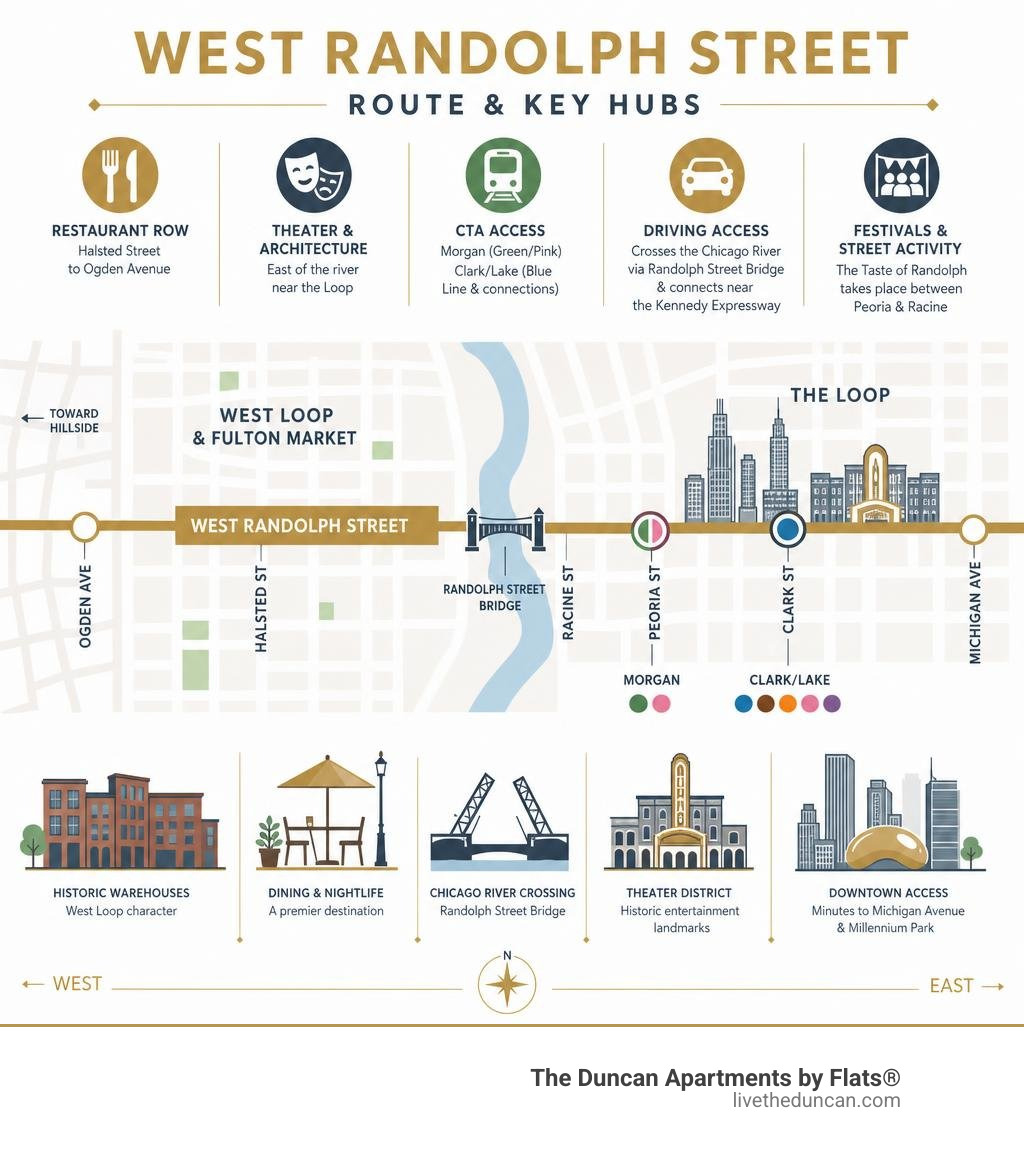
West Randolph Street Chicago is an east-west route that links the Loop with the West Loop and Fulton Market, continuing west toward Hillside. For most visitors, the best-known stretch is Restaurant Row, roughly between Halsted Street and Ogden Avenue, where dining, nightlife, offices, and historic warehouse buildings shape the street's energy.
| Looking for | Where to start |
|---|---|
| Restaurant Row | West Randolph Street between Halsted Street and Ogden Avenue |
| Loop theaters and architecture | East of the river, near Clark Street, Dearborn Street, and Michigan Avenue |
| CTA access | Morgan station on the Green and Pink Lines; Clark/Lake for the Blue Line and other connections |
| Driving from downtown | Randolph Street crosses the Chicago River via the Randolph Street Bridge and connects near the Kennedy Expressway |
| Festivals and street activity | The Taste of Randolph takes place on Randolph between Peoria and Racine streets |
Randolph Street dates to Chicago's original 1830s plat, but its modern identity is closely tied to the West Loop's shift from industrial uses to a busy dining, culture, and business district. It is a practical corridor for a meal, a show, a commute, or a walk through one of Chicago's fastest-changing urban areas.
History and Architectural Legacy of West Randolph Street Chicago
The origins of Randolph Street trace directly back to James Thompson's original 1830 survey and plat of Chicago. Named in honor of Randolph County, Illinois—which itself was named after Edmund Randolph, the first Attorney General of the United States and governor of Virginia—the thoroughfare has continuously served as a central vein for the city's commercial and civic evolution.
During the mid-19th century, the downtown stretch of Randolph Street acquired a colorful reputation. In the 1850s and 1860s, a concentration of bustling saloons, gaming houses, and taverns dominated the block, leading locals to nickname it the "Hairtrigger Block" due to frequent gunfights and fiery disputes. As Chicago rebuilt rapidly following the Great Chicago Fire of 1871, the street shed its rough-and-tumble saloon image, rising as a dignified home for theater houses, civic centers, and commercial hubs.
As you head toward the Loop, Randolph Street displays towering architectural landmarks. Among the most notable is Randolph Tower at 188 W. Randolph Street. Built during the 1920s in stunning Gothic Revival style, this landmark skyscraper features ornate terra-cotta detailing and a soaring profile that defines the skyline near the theater district.
Evolution from Meatpacking District to Modern Commercial Hub
Further west along west randolph street chicago, the corridor historically took on a distinctly industrial purpose. Throughout the late 19th and mid-20th centuries, the West Loop served as Chicago’s wholesale market and meatpacking epicenter. Heavy produce trucks, wholesale food distributors, cold storage plants, and busy processing facilities lined the cobblestone streets.
Over the past few decades, this former industrial zone underwent a remarkable urban transformation:
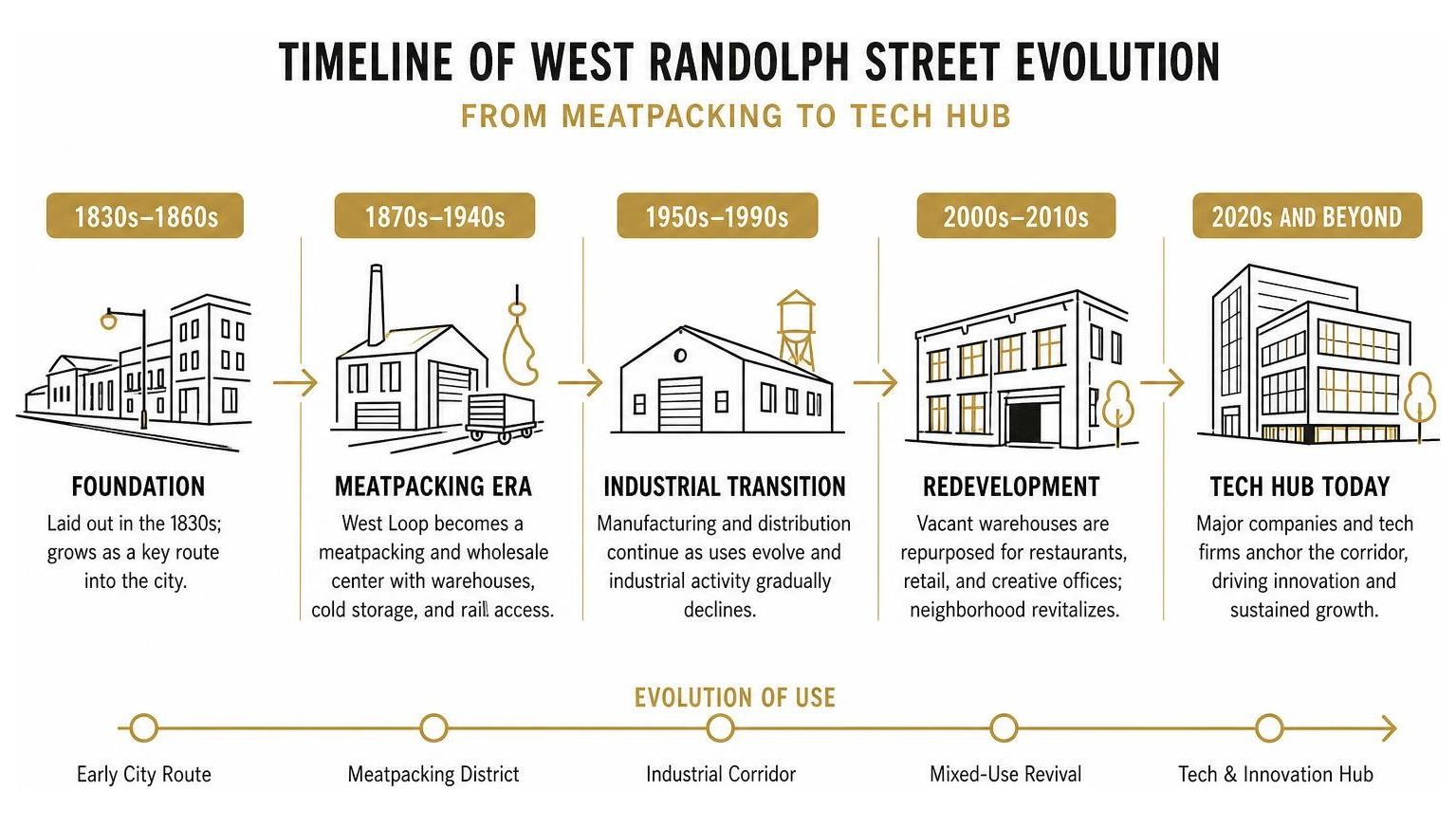
As industrial operations migrated out of downtown, visionary restaurateurs and developers recognized the historic character of the timber-and-brick warehouses. Brick facades, loading docks, and high wood-beamed ceilings were preserved and transformed into bright open-concept dining venues, creative tech offices, and boutique shopping spots.
Major corporate players soon followed. Today, the street hosts high-profile global operations, such as the 490,000-square-foot corporate headquarters for McDonald's at 1035 W. Randolph Street—complete with a unique global menu restaurant on its ground level. Right around the corner, tech giant Google anchors the nearby 1K Fulton building. This shift has elevated properties like 907-909 W. RANDOLPH STREET & 126 N. PEORIA STREET WEST LOOP · CHICAGO, IL into high-demand commercial locations boasting expansive retail street frontage.
The Culinary Scene on Restaurant Row
No discussion of west randolph street chicago is complete without exploring its globally celebrated corridor known as Restaurant Row. Spanning roughly from Halsted Street west to Ogden Avenue, this high-density stretch features over 30 distinct dining options within just a few blocks.
Restaurant Row caters to every palate, offering everything from relaxed diner fare to Michelin-recognized tasting menus. Check out a comprehensive guide on restaurants west randolph street chicago for an in-depth tour of the neighborhood's famous culinary establishments.
For first-time visitors, navigating this lively dining strip can be an exciting experience. To get the most out of your visit, read the Complete Guide For Navigating Chicago's Restaurant Row ... to learn about reservation strategies, peak dining hours, and neighborhood highlights.
Top Dining Spots on West Randolph Street Chicago
The variety of cuisine along West Randolph Street makes every block a culinary adventure. Diners can explore a spectrum of flavors, including:
- Globally-Inspired Small Plates: Award-winning concepts serve up creative shareable dishes, inviting diners to mix and match cold and hot plates, globally spiced dishes, and inventive desserts.
- Classic Italian & Artisanal Pizzerias: Traditional Italian venues blend family recipes with modern techniques. You can find places featuring handmade mosaic-tiled ovens brought straight from Italy, cooking authentic Neapolitan pizzas at temperatures exceeding 600 degrees.
- Artisanal Burgers & Diners: Iconic, upscale burger spots are world-famous for their decadent multi-patty cheeseburgers. Because many top spots operate on a walk-in-only basis, visiting during off-peak hours (such as mid-afternoon between 3:00 PM and 5:00 PM) is a great strategy to bypass long waits.
- Urban Wineries & Rooftop Dining: Combining wine-making with live entertainment, multi-story urban wineries offer curated menus with hundreds of varietals. Nearby rooftop spots serve weekend brunch featuring panoramic views of the Chicago skyline.
Festivals, Culture, and Community Events
West Randolph Street is also a vibrant center for community gathering, street festivals, and arts programming throughout the year.
The crown jewel of the summer festival season is the annual Taste of Randolph. Celebrating 29 years of neighborhood history, this popular three-day summer festival brings together top culinary vendors from Restaurant Row alongside multiple live music stages. Organized in partnership with the West Loop Community Organization, the street fest stretches along Randolph Street between Peoria and Racine streets, bringing incredible energy, music fans, and food lovers to the neighborhood.
Theater District Connections and Cultural Landmarks
Moving east along Randolph Street toward the Loop brings you directly into Chicago’s legendary Theater District. Across from historic office towers like Randolph Tower sits the Cadillac Palace Theatre, where major Broadway productions, touring musicals, and national performances take center stage. Surrounding venues like Randolph Tavern feature classic pub fare, Cajun dishes, and a 200-foot aged copper bar right in the middle of show-season bustle.
Cultural experiences continue across the West Loop:
- WNDR Museum: An interactive museum located nearby, merging technology, light, and multisensory art installations.
- Epiphany Center for the Arts: A restored 19th-century historic church converted into a venue for live music, art exhibitions, and cultural programming.
- Greektown Cultural Attractions: Just south of Randolph, Greektown features rich heritage sites including the National Hellenic Museum, the second oldest American institution dedicated to Greek culture.
Real Estate, Infrastructure, and Transit Navigation
Navigating and understanding West Randolph Street requires a look at its multi-layered infrastructure and real estate profile. The street bridges downtown commercial towers with West Loop industrial lofts.
| Property Type | Common Features along West Randolph | Key Characteristics |
|---|---|---|
| Historic Loft Buildings | Exposed brick, heavy timber beams, high ceilings | Converted warehouse structures housing residential units and creative offices |
| Luxury High-Rises | Glass facades, outdoor balconies, full amenities | Modern developments offering urban skyline views and fitness centers |
| Commercial Retail | Ground-floor frontage, outdoor patio potential | High pedestrian foot traffic ideal for dining, retail, and corporate hubs |
East of the Chicago River, Randolph Street utilizes a multi-level street layout (upper, middle, and lower levels) engineered to separate local commercial deliveries, garage access, and express traffic heading toward Lake Shore Drive (US 41). West of the river, the Randolph Street Bridge carries westbound traffic seamlessly across the water and offers direct connections to the Kennedy Expressway (I-90/I-94).
Interested in public real estate records and property metrics? You can review West Randolph Street in Chicago, IL Public Real Estate Info | BlockShopper for detailed parcel data and ownership history along the street.
Real Estate, Lofts, and Living on West Randolph Street Chicago
The real estate landscape along West Randolph Street reflects the West Loop’s rise as one of the city's most desirable places to live and work. The residential character is defined by a blend of converted turn-of-the-century timber lofts and contemporary residential towers. High-visibility ground-floor spaces are filled with retail boutiques, coffee shops, and world-class dining establishments.
Commercial development along the corridor remains robust, driven by corporate headquarter relocations and high pedestrian traffic. Residential homes along Randolph Street offer direct access to tech workplaces, award-winning dining, and public transit connections.
Transit Options, Parking, and Accessibility
Getting to and around West Randolph Street is exceptionally easy using Chicago's public transportation grid:
- CTA Elevated Trains: The Morgan station (serving both the Green and Pink Lines) places riders directly in the heart of Restaurant Row at Randolph and Morgan streets. To the east in the Loop, the Clark/Lake CTA station provides direct access to the Blue Line and major elevated routes.
- Metra Commuter Rail: Both Ogilvie Transportation Center and Union Station are located within walking distance of West Randolph Street, making suburban commutes quick and painless.
- Vehicle Parking: Dedicated public parking structures, such as the Plumbers Union Hall garage on Randolph Street, offer convenient vehicle parking.
- Rideshare & Biking: Designated rideshare drop-off zones operate along parallel side streets (such as Washington Boulevard), and dedicated bike lanes run along nearby West Loop corridors.
Frequently Asked Questions about West Randolph Street
What is Restaurant Row on West Randolph Street?
Restaurant Row is the famous culinary stretch of West Randolph Street, running between Halsted Street and Ogden Avenue. It features over 30 top-tier dining options, including Michelin-recognized tasting menus, burger spots, pizzerias, and international cuisine.
How do I get to West Randolph Street using public transit?
You can easily reach West Randolph Street by taking the CTA Green or Pink Line to the Morgan station, located right in the West Loop. You can also take the Blue Line or other CTA train lines to Clark/Lake in the Loop and walk west across the Randolph Street Bridge, or take Metra trains into nearby Ogilvie Transportation Center or Union Station.
Why was Randolph Street historically called the Hairtrigger Block?
In the 1850s and 1860s, the downtown portion of Randolph Street featured a dense concentration of gambling saloons and lively taverns. Frequent disputes and shootouts among patrons earned the stretch the local nickname "Hairtrigger Block."
Conclusion
From its 1830s origins as part of Chicago’s first city map to its mid-century meatpacking era and its current status as a culinary powerhouse, West Randolph Street showcases the best of Chicago’s reinvention. Whether you are catching a show in the Theater District, enjoying small plates along Restaurant Row, or attending summer street festivals, the corridor offers non-stop energy and rich historical character.
For those looking to live near this world-class dining and cultural hub, modern residential living options put you right in the center of the West Loop. Explore West Loop Apartments at The Duncan to find stylish floor plans and modern residential amenities—including an indoor pool and rooftop lounge—just minutes from everything West Randolph Street has to offer.


